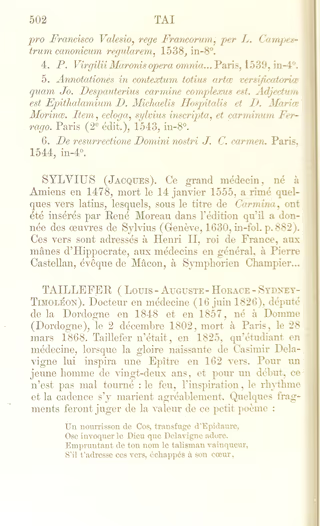
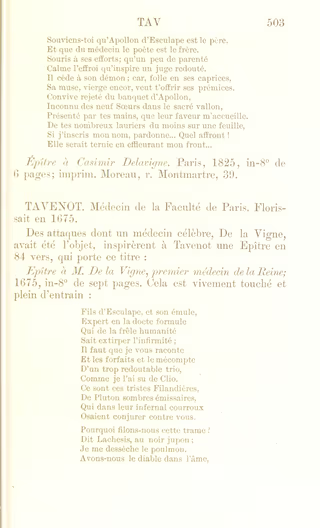
Un nourrisson de Cos, transfuge d'Epidaure,

Poet
TAILLEFER (LOUIS-AUGUSTE-HORACE-SYDNEY- TIMOLÉON)
Form
Alexandrin
Open the page in the book
The pages this poem fills. Each opens in the Le Parnasse médical français reader.

Hover or tap a word to see its match.

A nursling of Cos, defector from Epidaurus,

Dares to invoke the God whom Delavigne adores.

Borrowing from your name the victorious talisman,

If he addresses to you these lines, escaped from his heart,

Remember that Apollo is the father of Aesculapius,

And that the poet is the brother of the physician.

Smile upon his efforts; let a little kinship

Calm the dread inspired by a fearsome judge.

He yields to his demon; for, wild in her caprices,

His muse, still a virgin, wishes to offer you her first fruits.

A rejected guest from Apollo's banquet,

Unknown to the nine Sisters in the sacred vale,

Presented by your hands, let their favor welcome me.

If on at least one leaf of your many laurels

I inscribe my name, forgive me... What an affront!

It would be tarnished in brushing against my brow...

Un nourrisson de Cos, transfuge d'Epidaure,

Ose invoquer le Dieu que Delavigne adore.

Empruntant de ton nom le talisman vainqueur,

S'il t'adresse ces vers, échappés à son cœur,

Souviens-toi qu'Apollon d'Esculape est le père,

Et que du médecin le poète est le frère.

Souris à ses efforts; qu'un peu de parenté

Calme l'effroi qu'inspire un juge redouté.

Il cède à son démon ; car, folle en ses caprices,

Sa muse, vierge encor, veut t'offrir ses prémices.

Convive rejeté du banquet d'Apollon,

Inconnu des neuf Sœurs dans le sacré vallon,

Présenté par tes mains, que leur faveur m'accueille.

De tes nombreux lauriers du moins sur une feuille,

Si j'inscris mon nom, pardonne... Quel affront !

Elle serait ternie en effleurant mon front...
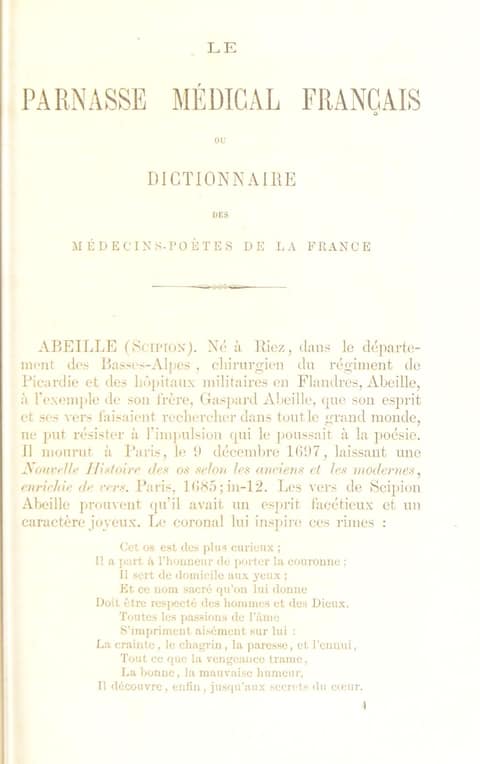
Title page of Le Parnasse médical français
Title page of Le Parnasse médical français , 1874

About this text

Provenance

This digital edition is derived from the Wellcome Collection copy of Achille Chéreau's 1874 dictionary of French physician-poets. The current reader uses the reacquired Wellcome IIIF JPEG corpus as the facsimile source of record.

Methodology

Each page is treated as a page-level unit. The page image remains the authority for the edition. Machine OCR is used as source OCR and reading aid, then corrected into French transcription, then translated into English. Word links connect the English translation to the French transcription and locations on the scans. Fifteen uncertain word-link decisions remain unlinked. Some links highlight only the text because the source word could not be located on the scan.

Rights

The source item is attributed to Wellcome Collection and marked with the Creative Commons Public Domain Mark. Poet Doctor's presentation adds generated transcription, translation, navigation metadata, and editorial context. No access control or anti-bulk-download measure should conflict with the public-domain status of the source material.

Original scans: Wellcome Collection ( Public Domain Mark 1.0 ).

Historian’s note. This text records the medicine of its own time, and later evidence has replaced most of it. It is not medical advice. We read it as history, and we ask what, if anything, connects it to medicine today. More on how we read old medical books