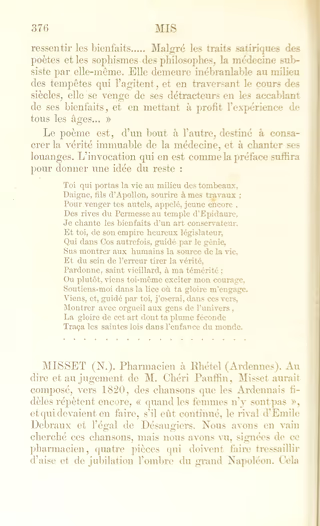
Toi qui portas la vie au milieu des tombeaux,

Poet
Antoine Miquel
Form
Alexandrines
Open the page in the book
The page this poem fills. Each opens in the Le Parnasse médical français reader.

Hover or tap a word to see its match.

You who brought life amidst the tombs,

Deign, son of Apollo, to smile upon my labors;

To avenge your altars, called, while yet young,

From the banks of the Permessus to the temple of Epidaurus,

I sing the benefits of a preserving art.

And you, happy legislator of its empire,

Who in Cos of old, guided by genius,

Knew how to show humans the source of life,

And from the bosom of error draw forth the truth,

Forgive, holy old man, my temerity;

Or rather, come yourself to rouse my courage,

Sustain me in the lists where your glory engages me.

Come, and, guided by you, I shall dare, in these verses,

To show with pride to the people of the universe,

The glory of this art of which your fecund pen

Traced the holy laws in the infancy of the world.

Toi qui portas la vie au milieu des tombeaux,

Daigne, fils d'Apollon, sourire à mes travaux ;

Pour venger tes autels, appelé, jeune encore ,

Des rives du Permesse au temple d'Epidaure,

Je chante les bienfaits d'un art conservateur.

Et toi, de son empire heureux législateur,

Qui dans Cos autrefois, guidé par le génie,

Sus montrer aux humains la source de la vie,

Et du sein de l'erreur tirer la vérité,

Pardonne, saint vieillard, à ma témérité ;

Ou plutôt, viens toi-même exciter mon courage,

Soutiens-moi dans la lice où ta gloire m'engage.

Viens, et, guidé par toi, j'oserai, dans ces vers,

Montrer avec orgueil aux gens de l'univers ,

La gloire de cet art dont ta plume féconde

Traça les saintes lois dans l'enfance du monde.
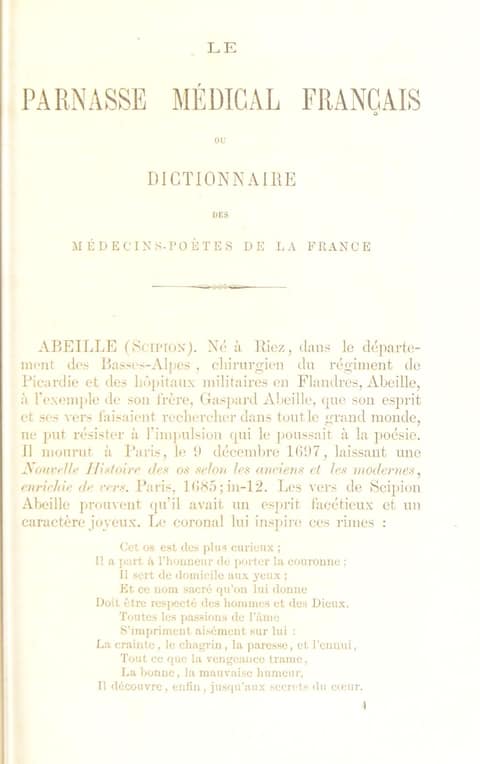
Title page of Le Parnasse médical français
Title page of Le Parnasse médical français , 1874

About this text

Provenance

This digital edition is derived from the Wellcome Collection copy of Achille Chéreau's 1874 dictionary of French physician-poets. The current reader uses the reacquired Wellcome IIIF JPEG corpus as the facsimile source of record.

Methodology

Each page is treated as a page-level unit. The page image remains the authority for the edition. Machine OCR is used as source OCR and reading aid, then corrected into French transcription, then translated into English. Word links connect the English translation to the French transcription and locations on the scans. Fifteen uncertain word-link decisions remain unlinked. Some links highlight only the text because the source word could not be located on the scan.

Rights

The source item is attributed to Wellcome Collection and marked with the Creative Commons Public Domain Mark. Poet Doctor's presentation adds generated transcription, translation, navigation metadata, and editorial context. No access control or anti-bulk-download measure should conflict with the public-domain status of the source material.

Original scans: Wellcome Collection ( Public Domain Mark 1.0 ).

Historian’s note. This text records the medicine of its own time, and later evidence has replaced most of it. It is not medical advice. We read it as history, and we ask what, if anything, connects it to medicine today. More on how we read old medical books