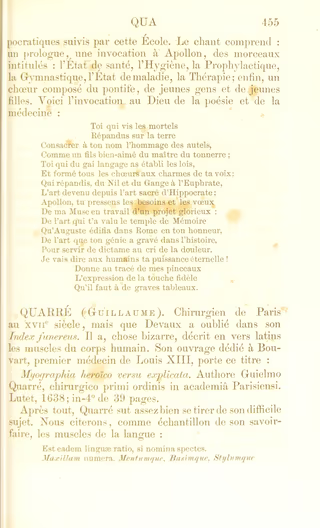
Toi qui vis les mortels

Poet
Pierre Py
Form
Mixed: hexasyllables, octosyllables, decasyllables and alexandrines
Open the page in the book
The page this poem fills. Each opens in the Le Parnasse médical français reader.

Hover or tap a word to see its match.

You who saw mortals

Spread across the earth

Dedicate the homage of altars to your name,

As a beloved son of the master of thunder;

You who established the laws of joyful speech,

And trained all choruses to the charms of your voice;

Who spread, from the Nile and the Ganges to the Euphrates,

The art that has since become the sacred art of Hippocrates;

Apollo, you foresee the needs and the desires

Of my Muse in labor with a glorious project:

Of the art that earned you the temple of Memory

That Augustus built in Rome in your honor,

Of the art that your genius engraved in history,

To serve as a balm for the cry of pain.

I am going to tell humans of your eternal power!

Give to the tracing of my brushes

The expression of the faithful touch

That is needed for solemn paintings.

Toi qui vis les mortels

Répandus sur la terre

Consacrer à ton nom l'hommage des autels,

Comme un fils bien-aimé du maître du tonnerre ;

Toi qui du gai langage as établi les lois,

Et formé tous les chœurs aux charmes de ta voix ;

Qui répandis, du Nil et du Gange à l'Euphrate,

L'art devenu depuis l'art sacré d'Hippocrate ;

Apollon, tu pressens les besoins et les vœux

De ma Muse en travail d'un projet glorieux :

De l'art qui t'a valu le temple de Mémoire

Qu'Auguste édifia dans Rome en ton honneur,

De l'art que ton génie a gravé dans l'histoire,

Pour servir de dictame au cri de la douleur.

Je vais dire aux humains ta puissance éternelle !

Donne au tracé de mes pinceaux

L'expression de la touche fidèle

Qu'il faut à de graves tableaux.
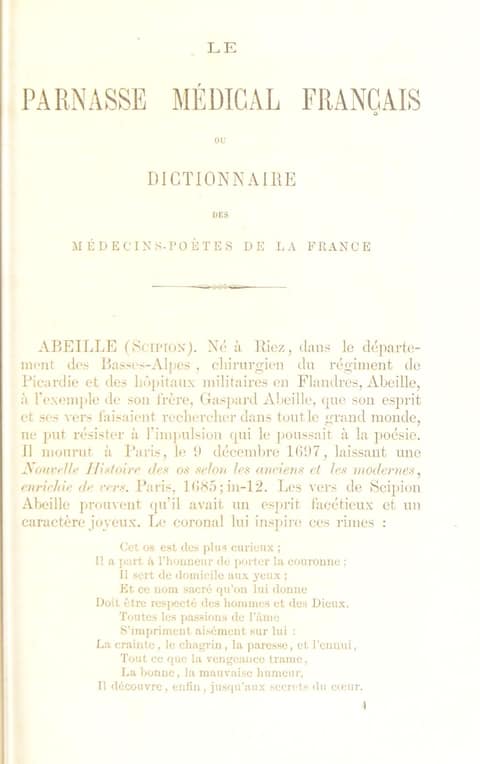
Title page of Le Parnasse médical français
Title page of Le Parnasse médical français , 1874

About this text

Provenance

This digital edition is derived from the Wellcome Collection copy of Achille Chéreau's 1874 dictionary of French physician-poets. The current reader uses the reacquired Wellcome IIIF JPEG corpus as the facsimile source of record.

Methodology

Each page is treated as a page-level unit. The page image remains the authority for the edition. Machine OCR is used as source OCR and reading aid, then corrected into French transcription, then translated into English. Word links connect the English translation to the French transcription and locations on the scans. Fifteen uncertain word-link decisions remain unlinked. Some links highlight only the text because the source word could not be located on the scan.

Rights

The source item is attributed to Wellcome Collection and marked with the Creative Commons Public Domain Mark. Poet Doctor's presentation adds generated transcription, translation, navigation metadata, and editorial context. No access control or anti-bulk-download measure should conflict with the public-domain status of the source material.

Original scans: Wellcome Collection ( Public Domain Mark 1.0 ).

Historian’s note. This text records the medicine of its own time, and later evidence has replaced most of it. It is not medical advice. We read it as history, and we ask what, if anything, connects it to medicine today. More on how we read old medical books