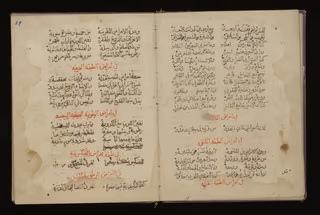
القول في امراض جفن العين بانواعها

Form
Rajaz
Open the page in the book
The page this poem fills. Each opens in the Ibn Sina's Urjuza fi al-tibb and other medical works in MS Arabic 129 reader.

The eye has diseases numbering four along with forty, arriving altogether

Like trachoma, stony hardening, and blepharitis, trichiasis, stye, and chalazion,

Likewise the scattering of eyelashes, and what afflicts the hair from turning inward,

Superfluous hair, and white eyelashes, thickness, and a knot that may occur,

Likewise ulcers, hives, and pannus, adhesion, hardening, and lice,

Ganglion, hailstone, and mulberry tumor, *wardīnaj*, wasting, then itching,

Irritation with apparent swelling, and lice and boils in the margins,

Erosion, hardness, relaxation, and excessive blinking, likewise gaping,

Death of blood, and greenness of dryness, Persian fire, and shivering,

A soft tumor, likewise "cow-like" disease, and redness with variation that has appeared,

Likewise relaxation with warts, and ringworm in the skin from dissolution.

لِلمُقلَةِ اَمراضٌ تُعَدُّ اَربَعة مَعَ اَربَعينَ قَد اتَت مُجتَمِعَة

كالجَرَبِ والتحجُّرِ والسَّلاقِ والشَّعْرَةِ والشَّعيرَةِ والشَّرْناقِ

كَذَاكَ الانْتِشَارُ مِن اهْدَابِ ومَا اعْتَرَى الشَّعرَ مِنِ انْقِلابِ

وزايِدُ الشَّعرِ وهُدْبُ ابيَضُ وغِلَظٌ وعُقدَةٌ قَد تَعرِضُ

كَذَا القُروحُ والشَّرَا والسَّبَلَة والالتِصَاقُ والجَسَا والقَمْلَة

وَسَلَعٌ وبَرَدٌ وتوتَة وردِيْنَجٌ وَذَبَلٌ فَحِكَّةُ

تهيُّجُ مَع انتفاخ ظاهِرِ والقَمْلُ والدُّمامُ في المَشافِرِ

تآكُلٌ صَلابَةٌ استِرخَاءُ وكَثرَةُ الطَّرفِ كَذَا الفَرَجانُ

موتُ دَمٍ وخُضرَةُ الجُفوف و نارٌ فارِسِيَّةٌ ونَافِضِي

وورَمٌ رِخْو كَذَا ذاتُ البَقَرْ وحُمرَةٌ مَع اختِلافٍ قَد ظَهَرْ

كَذَاكَ الاستِرْخَا مَع الثآليلِ وسَعفَةٌ في الجِلدِ مِن تَحليلِ
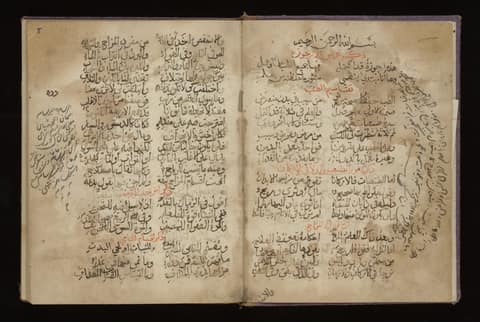
Title page of Ibn Sina's Urjuza fi al-tibb and other medical works in MS Arabic 129
Title page of Ibn Sina's Urjuza fi al-tibb and other medical works in MS Arabic 129 , 1700

About this text

Provenance

MS Arabic 129 is a handwritten Arabic medical volume held by Wellcome Collection in London. It is a composite manuscript: a single volume that brings together 11 separate works. They cover bloodletting, circumcision, the seasons, anatomy, the pulse, and urine, and most are in verse. Most of the verse in this edition is Ibn Sina's Urjuza fi al-tibb, a long poem on medicine, identified from the catalog card in the scans and from the poem's opening lines. Wellcome also names Ibn al-Tilmidh and Ibn Makki among the authors. Shams al-Din ibn Makki wrote three short poems here, and some pieces cannot be identified from the book. The manuscript is undated, and Wellcome estimates it as 18th century.

Methodology

Each scan is treated as a page-level unit. The page image remains the authority for the edition. Local Arabic Kraken OCR was weak and used only as auxiliary context; Gemini generated scan-grounded Arabic transcription and English translation primarily from the manuscript images and the approved glossary. Some word links remain uncertain, and some words have no reliable location on the scan.

Rights

The Wellcome Collection source record marks the digital surrogate with the Public Domain Mark 1.0. Poet Doctor's presentation adds generated OCR, transcription, translation, navigation metadata, and editorial context.

Original scans: Wellcome Collection ( Public Domain Mark 1.0 ).

Historian’s note. This text records the medicine of its own time, and later evidence has replaced most of it. It is not medical advice. We read it as history, and we ask what, if anything, connects it to medicine today. More on how we read old medical books