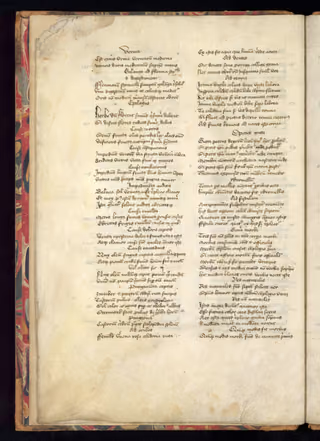
Species gutte

Form
Not identifiable from book
Open the page in the book
The page this poem fills. Each opens in the Regimen sanitatis Salernitanum reader.

Hover or tap a word to see its match.

Types of gout

Gout seeking the right side makes it paralytic;

If it seeks the feet, gout will be generated from it;

If it seeks the hands, chiragra will be generated from it;

In the joint of a limb, arthritica is born from it;

If it seeks the hip, from it comes the sciatic plague;

Tetanus will hold the whole limb stretched out.

Gutta petens dextrū latic̄ facͭ hoc p̄alitic̄

Si petit īpa pedes ḡnabit̄ inde podaḡ

Si petit īpa manꝰ gen̄abit̄ inde ciragra

Membri iūctura archetica nascitur inde

Si petit īpa scia fit ab īpa ciatica pestꝭ

Thetanus expansū totū mēbrū r̄tinebit
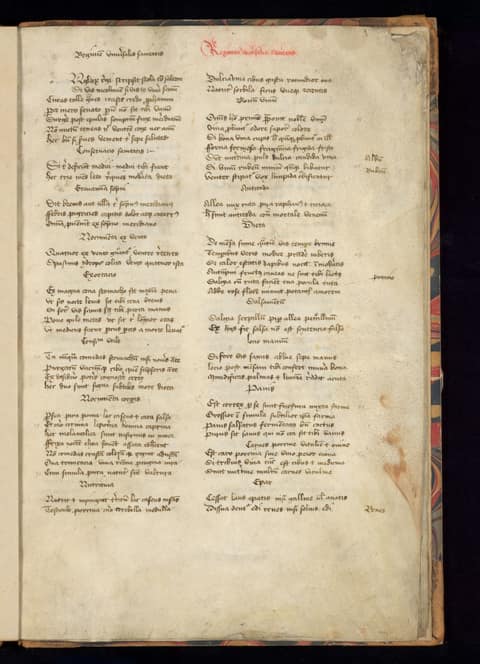
Title page of Regimen sanitatis Salernitanum
Title page of Regimen sanitatis Salernitanum , 1450

About this text

Provenance

This edition uses the Wellcome Collection images of MS 673 (catalogue number b19638425). Scans 1 to 30 show the binding, the flyleaves and the nine leaves. The Regimen fills folios 1r to 7v (scans 7 to 20). The English poems and receipts are on folios 7v to 9r (scans 20 to 23). The Wellcome images of the spine, the edges and the colour chart are not included.

The English additions are in less formal hands, and some letters are rubbed or lost. In the transcription of these pages, [?] marks letters that cannot be read.

Rights

The Wellcome Collection marks the digital images with the Public Domain Mark 1.0. Credit the Wellcome Collection.

Original scans: Wellcome Collection ( Public Domain Mark 1.0 ).

Historian’s note. This text records the medicine of its own time, and later evidence has replaced most of it. It is not medical advice. We read it as history, and we ask what, if anything, connects it to medicine today. More on how we read old medical books