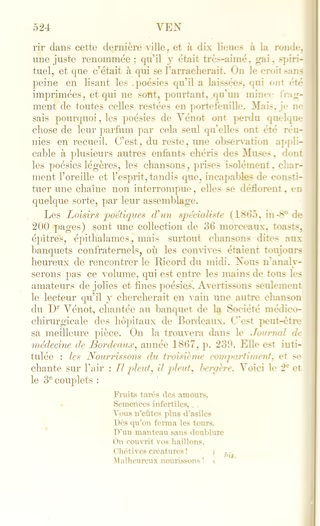
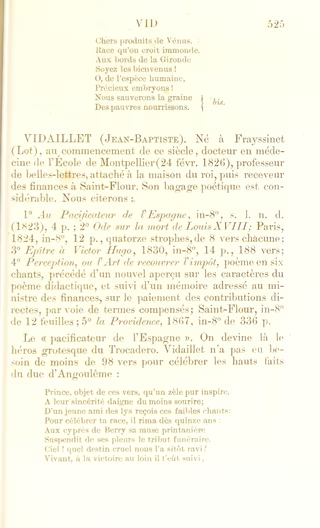
les Nourrissons du troisième compartiment

Poet
VÉNOT (Jean-Baptiste)
Form
Hexasyllable
Open the page in the book
The pages this poem fills. Each opens in the Le Parnasse médical français reader.

Hover or tap a word to see its match.

Spoiled fruits of love,

Infertile seeds,

You had no more asylums

As soon as the foundling wheels were closed.

With an unlined cloak

They covered your rags,

Puny creatures!

Miserable infants!

Dear products of Venus,

Race believed to be impure,

On the banks of the Gironde

Be welcome!

O, of the human species,

Precious embryos!

We will save the seed

Of the poor infants.

Fruits tarés des amours,

Semences infertiles,

Vous n'eûtes plus d'asiles

Dès qu'on ferma les tours.

D'un manteau sans doublure

On couvrit vos haillons,

Chétives créatures !

Malheureux nourissons !

Chers produits de Vénus,

Race qu'on croit immonde,

Aux bords de la Gironde

Soyez les bienvenus !

O, de l'espèce humaine,

Précieux embryons !

Nous sauverons la graine

Des pauvres nourrissons.
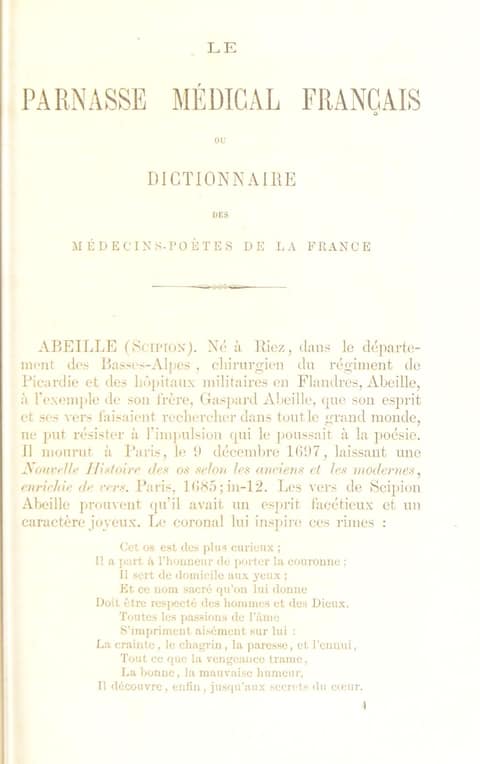
Title page of Le Parnasse médical français
Title page of Le Parnasse médical français , 1874

About this text

Provenance

This digital edition is derived from the Wellcome Collection copy of Achille Chéreau's 1874 dictionary of French physician-poets. The current reader uses the reacquired Wellcome IIIF JPEG corpus as the facsimile source of record.

Methodology

Each page is treated as a page-level unit. The page image remains the authority for the edition. Machine OCR is used as source OCR and reading aid, then corrected into French transcription, then translated into English. Word links connect the English translation to the French transcription and locations on the scans. Fifteen uncertain word-link decisions remain unlinked. Some links highlight only the text because the source word could not be located on the scan.

Rights

The source item is attributed to Wellcome Collection and marked with the Creative Commons Public Domain Mark. Poet Doctor's presentation adds generated transcription, translation, navigation metadata, and editorial context. No access control or anti-bulk-download measure should conflict with the public-domain status of the source material.

Original scans: Wellcome Collection ( Public Domain Mark 1.0 ).

Historian’s note. This text records the medicine of its own time, and later evidence has replaced most of it. It is not medical advice. We read it as history, and we ask what, if anything, connects it to medicine today. More on how we read old medical books