Hover or tap a word to see its match.
They have closed the doors of the School;
By a chance that I believe unparalleled,
On the carpet, at the council tables,
Expressly so that the mob might defile it,
All our judges have left their attire.
Robes, caps, everything is there pell-mell,
Except, however, Orfila's robe,
Which, through a notorious care for prudence,
Its owner placed behind a wardrobe,
Before which, like true savages,
All our heroes wallow on their knees.
One would have said, evil be to him who evil thinks!
That the dean knew all that in advance.
Is it chance, or rather prescience,
Or else so that penance might be done
For so much excess and so much license?
It is both: a clever dean,
For his salvation keeps more than one means;
And when one thinks to lead him in handcuffs,
With bare foils he riddles you with thrusts.
On the desks of the doctor-mill,
One had to see then to what heights
The robes and caps were leaping;
As a knave shakes his trinkets,
They tormented those miserable rags.
They trampled them, alas! under their heels,
They played with them as one plays with a ball.
Were you then conceived for this outrage,
Noble camails of noble parrots?
Had you constituted two centuries of heritage,
And without a snag suffered the verbiage
Of thirty peers with disgusting hiccups,
To be thus delivered to these villains,
And mercilessly torn by their hands?...
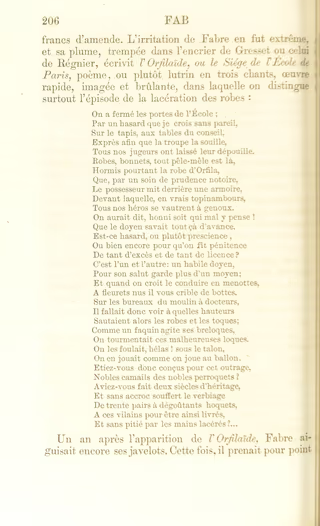
On a fermé les portes de l'École ;
Par un hasard que je crois sans pareil,
Sur le tapis, aux tables du conseil,
Exprès afin que la troupe la souille,
Tous nos jugeurs ont laissé leur dépouille.
Robes, bonnets, tout pêle-mêle est là,
Hormis pourtant la robe d'Orfila,
Que, par un soin de prudence notoire,
Le possesseur mit derrière une armoire,
Devant laquelle, en vrais topinambours,
Tous nos héros se vautrent à genoux.
On aurait dit, honni soit qui mal y pense !
Que le doyen savait tout çà d'avance.
Est-ce hasard, ou plutôt prescience,
Ou bien encore pour qu'on fît pénitence
De tant d'excès et de tant de licence ?
C'est l'un et l'autre : un habile doyen,
Pour son salut garde plus d'un moyen ;
Et quand on croit le conduire en menottes,
A fleurets nus il vous crible de bottes.
Sur les bureaux du moulin à docteurs,
Il fallait donc voir à quelles hauteurs
Sautaient alors les robes et les toques ;
Comme un faquin agite ses breloques,
On tourmentait ces malheureuses loques.
On les foulait, hélas ! sous le talon,
On en jouait comme on joue au ballon.
Etiez-vous donc conçus pour cet outrage,
Nobles camails des nobles perroquets ?
Aviez-vous fait deux siècles d'héritage,
Et sans accroc souffert le verbiage
De trente pairs à dégoûtants hoquets,
A ces vilains pour être ainsi livrés,
Et sans pitié par les mains lacérés ?...