Hover or tap a word to see its match.
Yes, I, whose breast has quivered with anger,
Who, quick to thwart an academic intrigue,
To slash an abuse with my bloody gibes,
Twenty times in two springs evoked Nemesis.
Today, dominated by an austere thought,
Pressing the caduceus with my austere hands,
Having ardently drunk from the divine cup,
I wish to realize a good of which I have dreamed,
To offer a noble example to my brothers in heart;
To chant the temple of Epidaurus and of Cos,
And of the tree of life, with ever-green branches,
Accustom the sap to the narrow yoke of verse.
I shall tell of what ills, an eternal pasture,
Man at birth borrows the seed from nature,
By what certain signs must shine the beacon
Of a happy prognosis, of a fatal augury,
When, with a prudent delay or a bold hand,
Art weakens, maintains, or breaks the disease,
And by what imprudence or what skill
Man loses, or preserves, or regains his health.
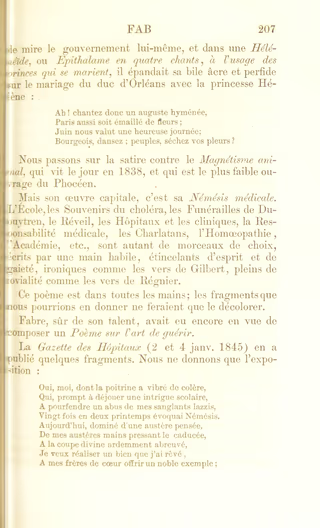
Oui, moi, dont la poitrine a vibré de colère,
Qui, prompt à déjouer une intrigue scolaire,
A pourfendre un abus de mes sanglants lazzis,
Vingt fois en deux printemps évoquai Némésis.
Aujourd'hui, dominé d'une austère pensée,
De mes austères mains pressant le caducée,
A la coupe divine ardemment abreuvé,
Je veux réaliser un bien que j'ai rêvé,
A mes frères de cœur offrir un noble exemple ;
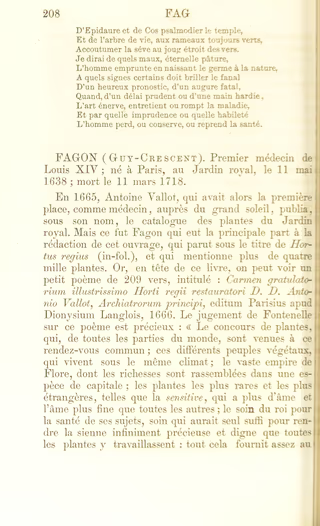
D'Epidaure et de Cos psalmodier le temple,
Et de l'arbre de vie, aux rameaux toujours verts,
Accoutumer la séve au joug étroit des vers.
Je dirai de quels maux, éternelle pâture,
L'homme emprunte en naissant le germe à la nature,
A quels signes certains doit briller le fanal
D'un heureux pronostic, d'un augure fatal,
Quand, d'un délai prudent ou d'une main hardie,
L'art énerve, entretient ou rompt la maladie,
Et par quelle imprudence ou quelle habileté
L'homme perd, ou conserve, ou reprend la santé.