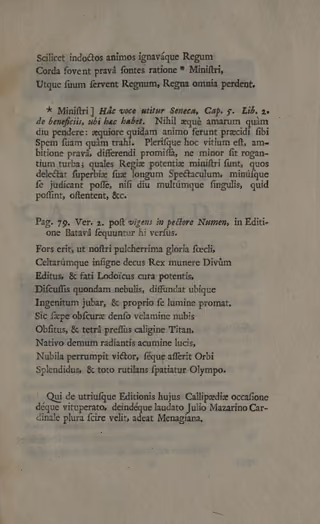
Fors erit, ut nostri pulcherrima gloria sœcli,

Form
Not identifiable from book
Open the page in the book
The page this poem fills. Each opens in the Callipaedia, seu de pulchrae prolis habendae ratione, poema didacticon reader.

Hover or tap a word to see its match.

Perhaps it will come to pass that the fairest glory of our age,

And distinguished ornament of the Celts, the King brought forth

By the gift of the Gods, Louis XIV, the care of mighty fate,

Having one day scattered the clouds, will diffuse everywhere

His innate radiance, and reveal himself by his own light.

Thus often covered by the dense veil of a dark cloud,

And oppressed by foul darkness, Titan

At last, with the native keenness of his radiant light,

Breaks through the clouds victorious, asserts himself to the World

In splendor, and courses glowing through the whole of Olympus.

Fors erit, ut nostri pulcherrima gloria sœcli,

Celtarúmque insigne decus Rex munere Divûm

Editus, & fati Lodoïcus cura potentis,

Discussis quondam nebulis, diffundat ubique

Ingenitum jubar, & proprio se lumine promat.

Sic sæpe obscuræ denso velamine nubis

Obsitus, & tetrâ pressus caligine Titan,

Nativo demum radiantis acumine lucis,

Nubila perrumpit victor, séque asserit Orbi

Splendidus, & toto rutilans spatiatur Olympo.
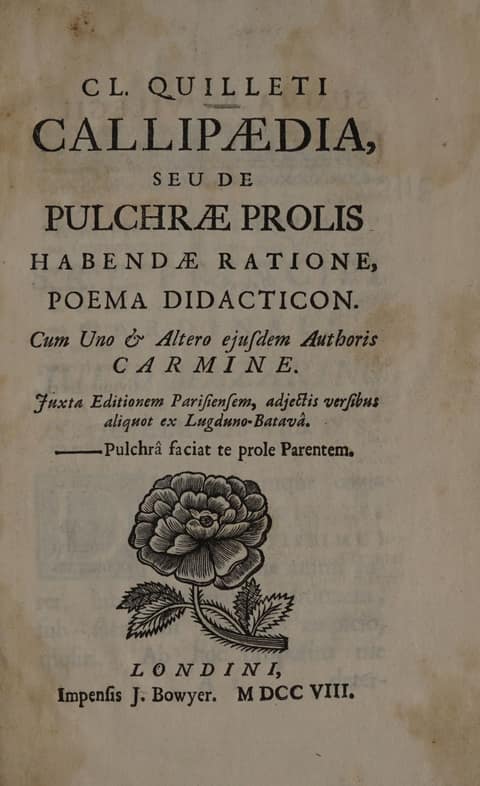
Title page of Callipaedia, seu de pulchrae prolis habendae ratione, poema didacticon
Title page of Callipaedia, seu de pulchrae prolis habendae ratione, poema didacticon , 1708

About this text

Provenance

This edition uses the Wellcome Collection copy, catalogue number b30503401. The scans include the binding, blank leaves and the summary of the privilege. Scan 7 is the title page.

Rights

The work is in the public domain by age. Wellcome Collection marks the scans with the Public Domain Mark 1.0. Credit Wellcome Collection. Poet Doctor is a non-commercial site.

Original scans: Wellcome Collection ( Public Domain Mark 1.0 ).

Historian’s note. This text records the medicine of its own time, and later evidence has replaced most of it. It is not medical advice. We read it as history, and we ask what, if anything, connects it to medicine today. More on how we read old medical books