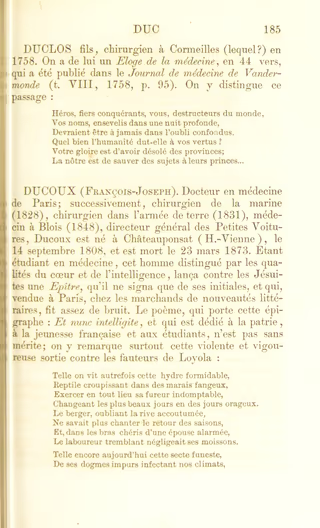
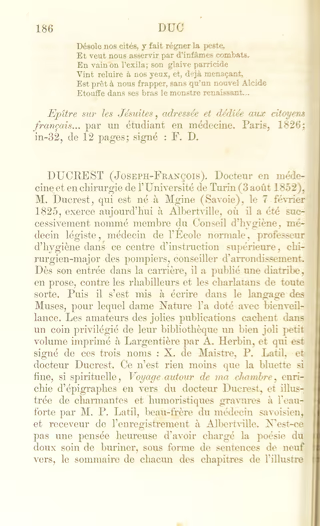
Telle on vit autrefois cette hydre formidable,

Poet
François-Joseph Ducoux
Form
Alexandrine
Open the page in the book
The pages this poem fills. Each opens in the Le Parnasse médical français reader.

Hover or tap a word to see its match.

Thus was seen in the past this formidable hydra,

A reptile stagnating in muddy marshes,

Exercising everywhere its indomitable fury,

Changing the most beautiful days into stormy days.

The shepherd, forgetting the accustomed shore,

No longer knew how to sing the return of the seasons,

And, in the cherished arms of an alarmed wife,

The trembling plowman neglected his harvests.

Such again today this baneful sect,

With its impure dogmas infecting our climes,

Desolates our cities, makes the plague reign there,

And wishes to enslave us through infamous battles.

In vain was it exiled; its parricidal sword

Came to gleam before our eyes, and, already threatening,

Is ready to strike us, unless a new Alcides

Smothers the reborn monster in his arms...

Telle on vit autrefois cette hydre formidable,

Reptile croupissant dans des marais fangeux,

Exercer en tout lieu sa fureur indomptable,

Changeant les plus beaux jours en des jours orageux.

Le berger, oubliant la rive accoutumée,

Ne savait plus chanter le retour des saisons,

Et, dans les bras chéris d'une épouse alarmée,

Le laboureur tremblant négligeait ses moissons.

Telle encore aujourd'hui cette secte funeste,

De ses dogmes impurs infectant nos climats,

Désole nos cités, y fait régner la peste,

Et veut nous asservir par d'infâmes combats.

En vain on l'exila; son glaive parricide

Vint reluire à nos yeux, et, déjà menaçant,

Est prêt à nous frapper, sans qu'un nouvel Alcide

Etouffe dans ses bras le monstre renaissant...
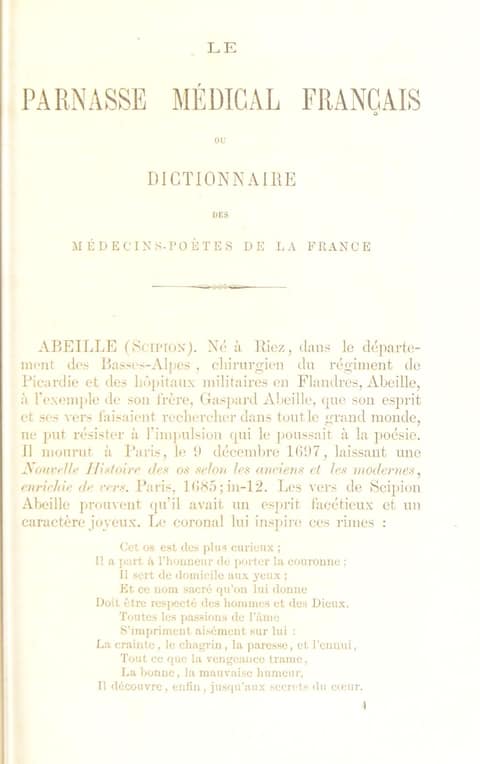
Title page of Le Parnasse médical français
Title page of Le Parnasse médical français , 1874

About this text

Provenance

This digital edition is derived from the Wellcome Collection copy of Achille Chéreau's 1874 dictionary of French physician-poets. The current reader uses the reacquired Wellcome IIIF JPEG corpus as the facsimile source of record.

Methodology

Each page is treated as a page-level unit. The page image remains the authority for the edition. Machine OCR is used as source OCR and reading aid, then corrected into French transcription, then translated into English. Word links connect the English translation to the French transcription and locations on the scans. Fifteen uncertain word-link decisions remain unlinked. Some links highlight only the text because the source word could not be located on the scan.

Rights

The source item is attributed to Wellcome Collection and marked with the Creative Commons Public Domain Mark. Poet Doctor's presentation adds generated transcription, translation, navigation metadata, and editorial context. No access control or anti-bulk-download measure should conflict with the public-domain status of the source material.

Original scans: Wellcome Collection ( Public Domain Mark 1.0 ).

Historian’s note. This text records the medicine of its own time, and later evidence has replaced most of it. It is not medical advice. We read it as history, and we ask what, if anything, connects it to medicine today. More on how we read old medical books