Hover or tap a word to see its match.
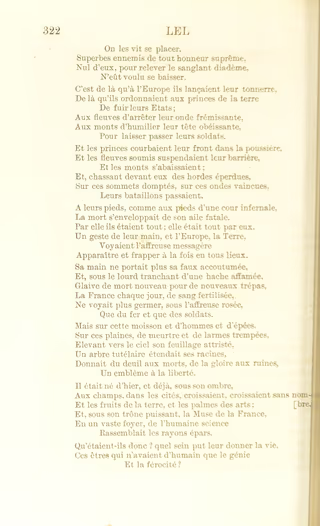
Frightening assembly of crime, of genius,
Bloody Areopagus of intrepid Dracos,
They were seven hundred Kings.
The earth beneath their footsteps gave birth to armies,
And the ancient renown of trembling courts
Bowed down at their voices.
A throne had fallen, all damp with murder:
Without fear and without pride, on its empty dais
They were seen to take their place.
Haughty enemies of any supreme honor,
None of them, to pick up the bloody diadem,
Would have wished to stoop.
It is from there that they hurled their thunder at Europe,
From there that they ordered the princes of the earth
To flee their States;
The rivers to halt their shuddering waves,
The mountains to humble their obedient heads,
To let their soldiers pass.
And the princes bowed their brows in the dust,
And the submissive rivers suspended their barrier,
And the mountains lowered themselves;
And, driving frantic hordes before them,
Over those conquered summits, over those vanquished waves,
Their battalions passed.
At their feet, as at the feet of an infernal court,
Death wrapped herself in her fatal wing.
Through her they were everything; she was everything through them.
A gesture of their hand, and Europe, the Earth,
Saw the dreadful messenger
Appear and strike at once in all places.
Her hand no longer bore its customary scythe,
And, beneath the heavy edge of a famished axe,
A new sword of death for new demises,
France every day, fertilized with blood,
Saw nothing more sprout, beneath the dreadful dew,
Save iron and soldiers.
But over this harvest of both men and swords,
Over these plains, drenched in murder and tears,
Raising its saddened foliage toward the sky,
A tutelary tree extended its roots,
Gave mourning to the dead, glory to the ruins,
An emblem to liberty.
It was born yesterday, and already, beneath its shade,
In the fields, in the cities, grew, grew without num-
Both the fruits of the earth, and the palms of the arts; [ber,
And, beneath its mighty throne, the Muse of France,
Into a vast hearth, of human science
Gathered the scattered rays.
What were they then? what womb could give them life,
These beings who had nothing human but genius
And ferocity?
They were what the bow is whose string is broken,
What the fleeing lead is beneath the burning powder,
Man returning to liberty.
And their end? Ask the homicidal axe,
Which saw with horror, under its livid edge,
Victims and executioners come to mix their blood;
Ask those fields of glory and carnage,
Where Europe saw them, as the price of their courage,
Fall in the first rank.
And their memory? When the devouring tomb
Comes to spill, in long waves, over the burning earth,
Terror, death, and fecundity,
At its dreadful thunder, all flee, all scatter.
The next day, the harrow
Rolls more softly over the devastated soil.
De crime, de génie, effrayant assemblage,
D'intrépides Dracons sanglant Aréopage,
Ils étaient sept cents Rois.
La terre sous leurs pas enfantait des armées,
Et des tremblantes cours les vieilles renommées
S'abaissaient à leurs voix.
Un trône était tombé, de meurtre tout humide :
Sans crainte et sans orgueil, sur son estrade vide
On les vit se placer.
Superbes ennemis de tout honneur suprême,
Nul d'eux, pour relever le sanglant diadème,
N'eût voulu se baisser.
C'est de là qu'à l'Europe ils lançaient leur tonnerre,
De là qu'ils ordonnaient aux princes de la terre
De fuir leurs Etats ;
Aux fleuves d'arrêter leur onde frémissante,
Aux monts d'humilier leur tête obéissante,
Pour laisser passer leurs soldats.
Et les princes courbaient leur front dans la poussière,
Et les fleuves soumis suspendaient leur barrière,
Et les monts s'abaissaient ;
Et, chassant devant eux des hordes éperdues,
Sur ces sommets domptés, sur ces ondes vaincues,
Leurs bataillons passaient.
A leurs pieds, comme aux pieds d'une cour infernale,
La mort s'enveloppait de son aile fatale.
Par elle ils étaient tout ; elle était tout par eux.
Un geste de leur main, et l'Europe, la Terre,
Voyaient l'affreuse messagère
Apparaître et frapper à la fois en tous lieux.
Sa main ne portait plus sa faux accoutumée,
Et, sous le lourd tranchant d'une hache affamée,
Glaive de mort nouveau pour de nouveaux trépas,
La France chaque jour, de sang fertilisée,
Ne voyait plus germer, sous l'affreuse rosée,
Que du fer et que des soldats.
Mais sur cette moisson et d'hommes et d'épées,
Sur ces plaines, de meurtre et de larmes trempées,
Elevant vers le ciel son feuillage attristé,
Un arbre tutélaire étendait ses racines,
Donnait du deuil aux morts, de la gloire aux ruines,
Un emblème à la liberté.
Il était né d'hier, et déjà, sous son ombre,
Aux champs, dans les cités, croissaient, croissaient sans nom-
Et les fruits de la terre, et les palmes des arts ; [bre,
Et, sous son trône puissant, la Muse de la France,
En un vaste foyer, de l'humaine science
Rassemblait les rayons épars.
Qu'étaient-ils donc ? quel sein put leur donner la vie,
Ces êtres qui n'avaient d'humain que le génie
Et la férocité ?
Ils étaient ce qu'est l'arc dont la corde est brisée,
Ce qu'est le plomb fuyant sous la poudre embrasée,
L'homme rentrant en liberté.
Et leur fin ? Demandez à la hache homicide,
Qui vit avec horreur, sous son tranchant livide,
Victimes et bourreaux venir mêler leur sang ;
Demandez à ces champs de gloire et de carnage,
Où l'Europe les vit, pour prix de leur courage,
Tomber au premier rang.
Et leur mémoire ? Quand la tombe dévorante
Vient répandre, à longs flots, sur la terre brûlante,
L'épouvante, la mort et la fécondité,
Sur son tonnerre affreux, tout fuit, tout se disperse.
Le lendemain, la herse
Roule plus mollement sur le sol dévasté.