Hover or tap a word to see its match.
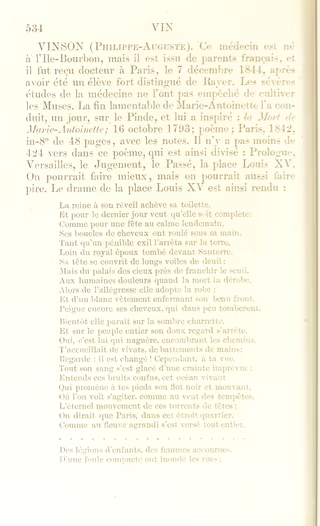
The queen upon waking completes her toilette,
And for the final day wishes it to be complete;
As if for a celebration on a calm morrow,
Her curls of hair have rolled beneath her hand.
As long as a painful exile kept her on earth,
Far from the royal spouse fallen before Santerre,
Her head was covered with long mourning veils;
But close to crossing the threshold of the palace of heaven,
When death steals her away from human sorrows,
Then she adopts the robe of jubilation;
And enclosing her beautiful brow in a white garment,
She combs again her hair, which shortly will fall.
Soon she appears upon the somber cart,
And upon the entire people her gentle gaze rests.
Yes, it is they who formerly, crowding the roads,
Welcomed you with cheers, with clapping of hands;
Look: they have changed! Yet, at the sight of you,
All their blood has frozen with an unforeseen fear;
Hear these confused noises, this living ocean
That drives at your feet its black and moving tide,
Where one sees churning, as in the wind of storms,
The eternal motion of these torrents of heads;
One would say that Paris, into this narrow quarter,
As into a swollen river, has poured itself entirely.
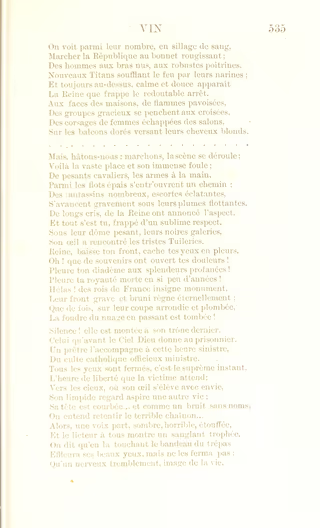
Legions of children, women hurrying near,
With a dense crowd have flooded the streets:
One sees among their number, in a wake of blood,
The Republic marching with reddening cap;
Men with bare arms, with robust chests,
New Titans blowing fire through their nostrils;
And always above, calm and gentle appears
The Queen struck by the dreadful decree.
At the facades of houses, bedecked with flames,
Graceful groups lean at the casements,
Bodices of women escaped from the salons,
On the gilded balconies pouring out their blond hair.
But, let us hasten; let us walk on, the scene unfolds;
Here is the vast square and its immense crowd;
Heavy horsemen, weapons in hand,
Among the thick waves open a path for themselves;
Numerous infantrymen, brilliant escorts,
Advance gravely beneath their floating plumes.
Long cries have announced the sight of the Queen,
And all fell silent, struck by a sublime respect.
Beneath their heavy dome, their black galleries,
Her eye met the sorrowful Tuileries.
Queen, lower your brow, hide your tearful eyes.
Oh! how many memories have awakened your sorrows!
Weep for your diadem with profaned splendors!
Weep for your royalty dead in so few years!
Alas! notable monument of the kings of France,
Their grave and browned brow reigns eternally;
How many times, on their rounded and leaden cupola,
The lightning of the passing cloud has fallen!
Silence! she has ascended to her final throne.
The one that before Heaven God gives to the prisoner.
A priest accompanies her at this sinister hour,
Officious minister of the Catholic faith.
All eyes are closed, it is the supreme instant,
The hour of liberty that the victim awaits;
Toward the heavens, where her eye rises with longing,
Her limpid gaze aspires to another life;
Her head is bowed... and like a nameless noise,
One hears the terrible chain resound...
Then, a voice rings out, dark, horrible, stifled,
And the lictor shows to all a bloody trophy.
They say that in touching her the blindfold of death
Brushed her beautiful eyes, but did not close them:
That a nervous trembling, image of life,
Moved, still rosy, her unquenched lip;
That a slow and gentle reflection, descended toward her brow,
Seemed a veil spread over her face;
Like the pallor that, at the whitening dawn,
The dazzling dance leaves upon exiting a ball,
When the day, parting the shadows of morning,
Projects its gleam to the distant horizon.
La reine à son réveil achève sa toilette,
Et pour le dernier jour veut qu'elle soit complète ;
Comme pour une fête au calme lendemain,
Ses boucles de cheveux ont roulé sous sa main.
Tant qu'un pénible exil l'arrêta sur la terre,
Loin du royal époux tombé devant Santerre,
Sa tête se couvrit de longs voiles de deuil ;
Mais du palais des cieux près de franchir le seuil,
Aux humaines douleurs quand la mort la dérobe,
Alors de l'allégresse elle adopte la robe ;
Et d'un blanc vêtement enfermant son beau front,
Peigne encore ses cheveux, qui dans peu tomberont.
Bientôt elle paraît sur la sombre charrette.
Et sur le peuple entier son doux regard s'arrête.
Oui, c'est lui qui naguère, encombrant les chemins,
T'accueillait de vivats, de battements de mains ;
Regarde : il est changé ! Cependant, à ta vue,
Tout son sang s'est glacé d'une crainte imprévue ;
Entends ces bruits confus, cet océan vivant
Qui promène à tes pieds son flot noir et mouvant,
Où l'on voit s'agiter, comme au vent des tempêtes,
L'éternel mouvement de ces torrents de têtes ;
On dirait que Paris, dans cet étroit quartier,
Comme au fleuve agrandi s'est versé tout entier.
Des légions d'enfants, des femmes accourues,
D'une foule compacte ont inondé les rues :
On voit parmi leur nombre, en sillage de sang,
Marcher la République au bonnet rougissant ;
Des hommes aux bras nus, aux robustes poitrines,
Nouveaux Titans soufflant le feu par leurs narines ;
Et toujours au-dessus, calme et douce apparaît
La Reine que frappe le redoutable arrêt.
Aux faces des maisons, de flammes pavoisées,
Des groupes gracieux se penchent aux croisées,
Des corsages de femmes échappées des salons,
Sur les balcons dorés versant leurs cheveux blonds.
Mais, hâtons-nous ; marchons, la scène se déroule ;
Voilà la vaste place et son immense foule ;
De pesants cavaliers, les armes à la main,
Parmi les flots épais s'entr'ouvrent un chemin ;
Des fantassins nombreux, escortes éclatantes,
S'avancent gravement sous leurs plumes flottantes.
De longs cris, de la Reine ont annoncé l'aspect,
Et tout s'est tu, frappé d'un sublime respect.
Sous leur dôme pesant, leurs noires galeries,
Son œil a rencontré les tristes Tuileries.
Reine, baisse ton front, cache tes yeux en pleurs.
Oh ! que de souvenirs ont ouvert tes douleurs !
Pleure ton diadème aux splendeurs profanées !
Pleure ta royauté morte en si peu d'années !
Hélas ! des rois de France insigne monument,
Leur front grave et bruni règne éternellement ;
Que de fois, sur leur coupe arrondie et plombée,
La foudre du nuage en passant est tombée !
Silence ! elle est montée à son trône dernier.
Celui qu'avant le Ciel Dieu donne au prisonnier.
Un prêtre l'accompagne à cette heure sinistre,
Du culte catholique officieux ministre.
Tous les yeux sont fermés, c'est le suprême instant,
L'heure de liberté que la victime attend ;
Vers les cieux, où son œil s'élève avec envie,
Son limpide regard aspire une autre vie ;
Sa tête est courbée... et comme un bruit sans noms,
On entend retentir le terrible chaînon...
Alors, une voix part, sombre, horrible, étouffée,
Et le licteur à tous montre un sanglant trophée.
On dit qu'en la touchant le bandeau du trépas
Effleura ses beaux yeux, mais ne les ferma pas :
Qu'un nerveux tremblement, image de la vie.
Emouvait, rose encore, sa lèvre inassouvie ;
Qu'un lent et doux reflet, vers son front descendu,
Semblait sur son visage un voile répandu ;
Pareil à la pâleur, qu'à l'aube blanchissante,
Laisse au sortir d'un bal la danse éblouissante,
Quand le jour, entr'ouvrant les ombres du matin,
Projette sa lueur à l'horizon lointain.