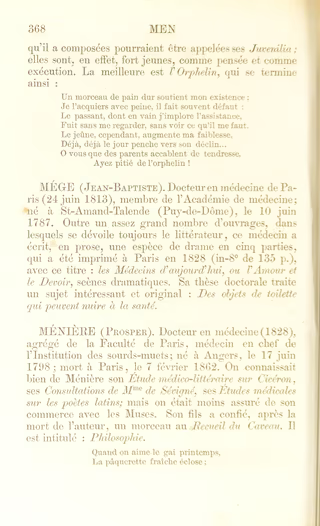
l'Orphelin

Poet
Henri-François Mayet
Form
Mixed (alexandrines and final octosyllable)
Open the page in the book
The page this poem fills. Each opens in the Le Parnasse médical français reader.

Hover or tap a word to see its match.

A piece of hard bread sustains my existence;

I acquire it with difficulty, it is often lacking:

The passerby, whose assistance I implore in vain,

Flees without looking at me, without seeing what I need.

Fasting, however, increases my weakness,

Already, already the day leans toward its decline...

O you whom parents shower with tenderness,

Have pity on the orphan!

Un morceau de pain dur soutient mon existence ;

Je l'acquiers avec peine, il fait souvent défaut :

Le passant, dont en vain j'implore l'assistance,

Fuit sans me regarder, sans voir ce qu'il me faut.

Le jeûne, cependant, augmente ma faiblesse,

Déjà, déjà le jour penche vers son déclin...

O vous que des parents accablent de tendresse,

Ayez pitié de l'orphelin !
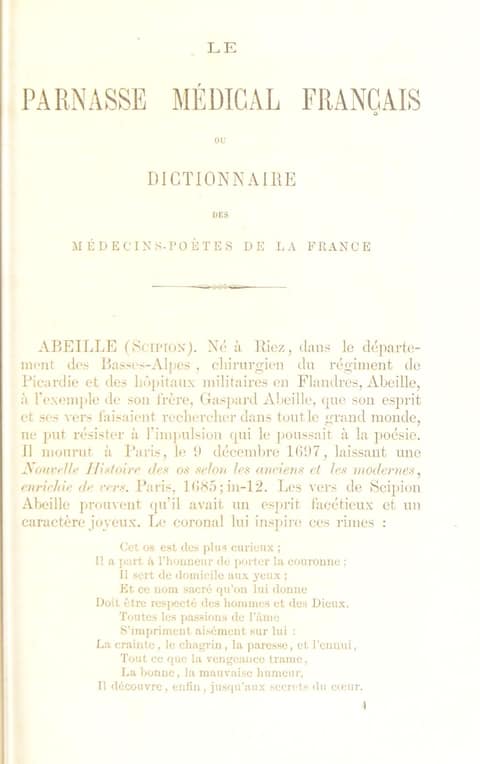
Title page of Le Parnasse médical français
Title page of Le Parnasse médical français , 1874

About this text

Provenance

This digital edition is derived from the Wellcome Collection copy of Achille Chéreau's 1874 dictionary of French physician-poets. The current reader uses the reacquired Wellcome IIIF JPEG corpus as the facsimile source of record.

Methodology

Each page is treated as a page-level unit. The page image remains the authority for the edition. Machine OCR is used as source OCR and reading aid, then corrected into French transcription, then translated into English. Word links connect the English translation to the French transcription and locations on the scans. Fifteen uncertain word-link decisions remain unlinked. Some links highlight only the text because the source word could not be located on the scan.

Rights

The source item is attributed to Wellcome Collection and marked with the Creative Commons Public Domain Mark. Poet Doctor's presentation adds generated transcription, translation, navigation metadata, and editorial context. No access control or anti-bulk-download measure should conflict with the public-domain status of the source material.

Original scans: Wellcome Collection ( Public Domain Mark 1.0 ).

Historian’s note. This text records the medicine of its own time, and later evidence has replaced most of it. It is not medical advice. We read it as history, and we ask what, if anything, connects it to medicine today. More on how we read old medical books