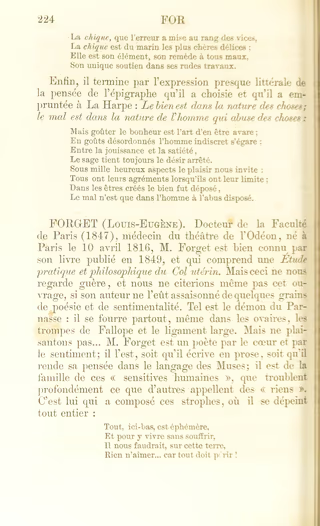
Tout, ici-bas, est éphémère,

Poet
Louis-Eugène Forget
Form
Octosyllabe
Open the page in the book
The pages this poem fills. Each opens in the Le Parnasse médical français reader.

Hover or tap a word to see its match.

Everything, here below, is ephemeral,

And to live here without suffering,

We would need, on this earth,

To love nothing... for everything must perish!

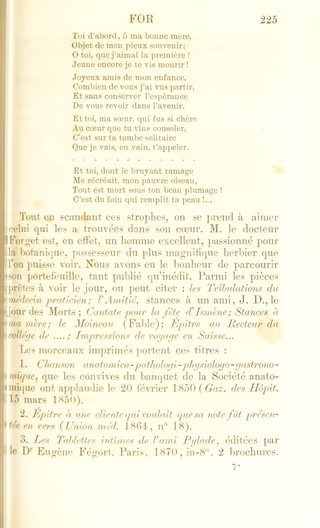
You first, O my good mother,

Object of my pious remembrance;

O you, whom I loved first!

Still young I saw you die!

Joyous friends of my childhood,

How many of you I have seen depart,

And without keeping the hope

Of seeing you again in the future.

And you, my sister, who were so dear

To the heart that you came to console,

It is at your solitary tomb

That I go, in vain, to call you.

And you, whose noisy warbling

Entertained me, my poor bird,

All is dead beneath your beautiful plumage!

It is hay that fills your skin!...

Tout, ici-bas, est éphémère,

Et pour y vivre sans souffrir,

Il nous faudrait, sur cette terre,

Rien n'aimer... car tout doit périr !

Toi d'abord, ô ma bonne mère,

Objet de mon pieux souvenir;

O toi, que j'aimai la première !

Jeune encore je te vis mourir !

Joyeux amis de mon enfance,

Combien de vous j'ai vus partir,

Et sans conserver l'espérance

De vous revoir dans l'avenir.

Et toi, ma sœur, qui fus si chère

Au cœur que tu vins consoler,

C'est sur ta tombe solitaire

Que je vais, en vain, t'appeler.

Et toi, dont le bruyant ramage

Me récréait, mon pauvre oiseau,

Tout est mort sous ton beau plumage !

C'est du foin qui remplit ta peau !...
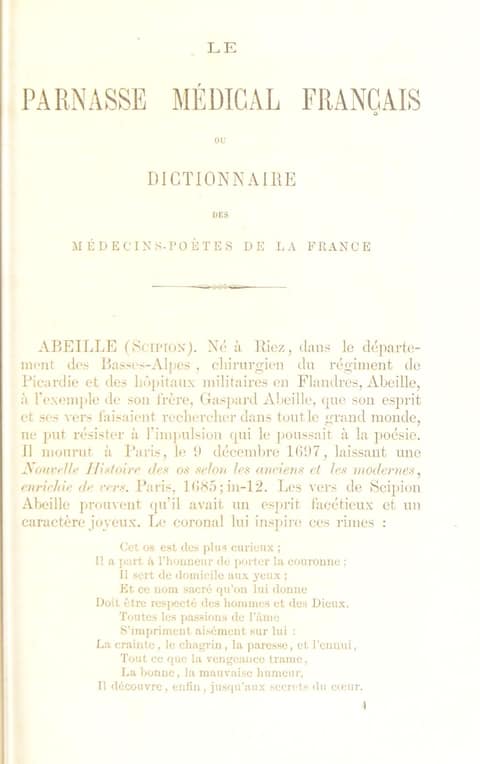
Title page of Le Parnasse médical français
Title page of Le Parnasse médical français , 1874

About this text

Provenance

This digital edition is derived from the Wellcome Collection copy of Achille Chéreau's 1874 dictionary of French physician-poets. The current reader uses the reacquired Wellcome IIIF JPEG corpus as the facsimile source of record.

Methodology

Each page is treated as a page-level unit. The page image remains the authority for the edition. Machine OCR is used as source OCR and reading aid, then corrected into French transcription, then translated into English. Word links connect the English translation to the French transcription and locations on the scans. Fifteen uncertain word-link decisions remain unlinked. Some links highlight only the text because the source word could not be located on the scan.

Rights

The source item is attributed to Wellcome Collection and marked with the Creative Commons Public Domain Mark. Poet Doctor's presentation adds generated transcription, translation, navigation metadata, and editorial context. No access control or anti-bulk-download measure should conflict with the public-domain status of the source material.

Original scans: Wellcome Collection ( Public Domain Mark 1.0 ).

Historian’s note. This text records the medicine of its own time, and later evidence has replaced most of it. It is not medical advice. We read it as history, and we ask what, if anything, connects it to medicine today. More on how we read old medical books