Hover or tap a word to see its match.
I shall see you no more! I have no more hope!
My Clotilde, for you eternity begins!
From your last sigh exhaled toward the heavens,
My mouth caught the precious breath;
Inexorable death, whom I begged but lately
To respect the days of a wife so dear,
Has preserved my own, which I consecrated to you.
Its scythe, by cutting them short, would have fulfilled my wishes.
Your sweet voice, alas! is forever extinguished!
And that look so tender where your soul was painted,
Your virtues, your beauty, your precocious talents,
Will not see your sixteenth spring shine forth!
So young! what, already snatched from my tenderness!
Ah! you live in my heart, you occupy it ceaselessly.
Overwhelmed with sorrow, it is your dear memory,
In so great a misfortune, that can sustain me.
I live to mourn you, I live in alarms;
I am relieved only by shedding tears.
Your desolate parents share my sorrows,
And to express them my eyes have no more tears.
To sing of you, my muse had strung her lyre,
And it is still your shade today that inspires her;
She raised for you her tenderest accents.
You are no more! these farewells... will be my final songs.
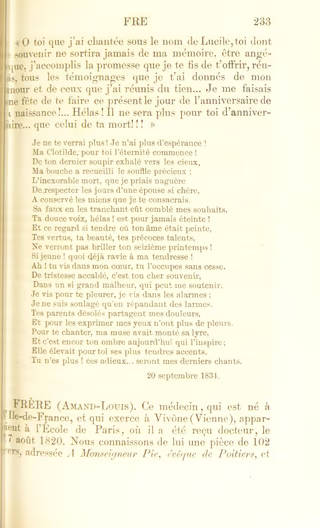
Je ne te verrai plus ! Je n'ai plus d'espérance !
Ma Clotilde, pour toi l'éternité commence !
De ton dernier soupir exhalé vers les cieux,
Ma bouche a recueilli le souffle précieux ;
L'inexorable mort, que je priais naguère
De respecter les jours d'une épouse si chère,
A conservé les miens que je te consacrais.
Sa faux en les tranchant eût comblé mes souhaits.
Ta douce voix, hélas ! est pour jamais éteinte !
Et ce regard si tendre où ton âme était peinte,
Tes vertus, ta beauté, tes précoces talents,
Ne verront pas briller ton seizième printemps !
Si jeune ! quoi déjà ravie à ma tendresse !
Ah ! tu vis dans mon cœur, tu l'occupes sans cesse.
De tristesse accablé, c'est ton cher souvenir,
Dans un si grand malheur, qui peut me soutenir.
Je vis pour te pleurer, je vis dans les alarmes ;
Je ne suis soulagé qu'en répandant des larmes.
Tes parents désolés partagent mes douleurs,
Et pour les exprimer mes yeux n'ont plus de pleurs.
Pour te chanter, ma muse avait monté sa lyre,
Et c'est encor ton ombre aujourd'hui qui l'inspire ;
Elle élevait pour toi ses plus tendres accents.
Tu n'es plus ! ces adieux... seront mes derniers chants.