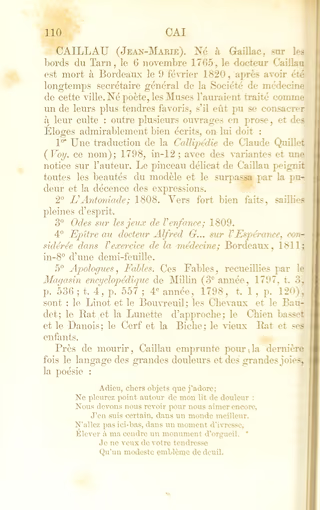
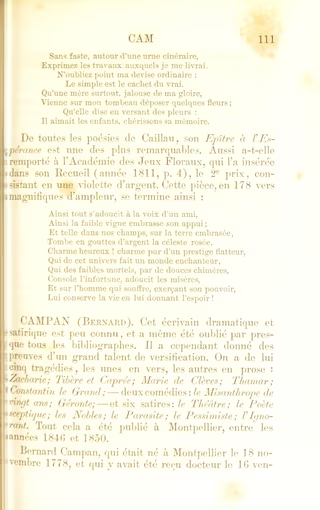
Adieu, chers objets que j'adore;

Poet
Jean-Marie Caillau
Form
Mixed
Open the page in the book
The pages this poem fills. Each opens in the Le Parnasse médical français reader.

Hover or tap a word to see its match.

Farewell, dear objects that I adore;

Do not weep around my bed of pain:

We must meet again to love each other still,

I am certain of it, in a better world.

Do not here below, in a moment of passion,

Raise to my ashes a monument of pride.

I want from your tenderness

Only a modest emblem of mourning.

Without pomp, around a cinerary urn,

Express the labors to which I devoted myself.

Do not forget my usual motto:

The simple is the hallmark of truth.

Above all, let a mother, jealous of my glory,

Come to lay some flowers upon my tomb;

Let her say while shedding tears:

He loved children, let us cherish his memory.

Adieu, chers objets que j'adore;

Ne pleurez point autour de mon lit de douleur :

Nous devons nous revoir pour nous aimer encore,

J'en suis certain, dans un monde meilleur.

N'allez pas ici-bas, dans un moment d'ivresse,

Élever à ma cendre un monument d'orgueil.

Je ne veux de votre tendresse

Qu'un modeste emblème de deuil.

Sans faste, autour d'une urne cinéraire,

Exprimez les travaux auxquels je me livrai.

N'oubliez point ma devise ordinaire :

Le simple est le cachet du vrai.

Qu'une mère surtout, jalouse de ma gloire,

Vienne sur mon tombeau déposer quelques fleurs ;

Qu'elle dise en versant des pleurs :

Il aimait les enfants, chérissons sa mémoire.
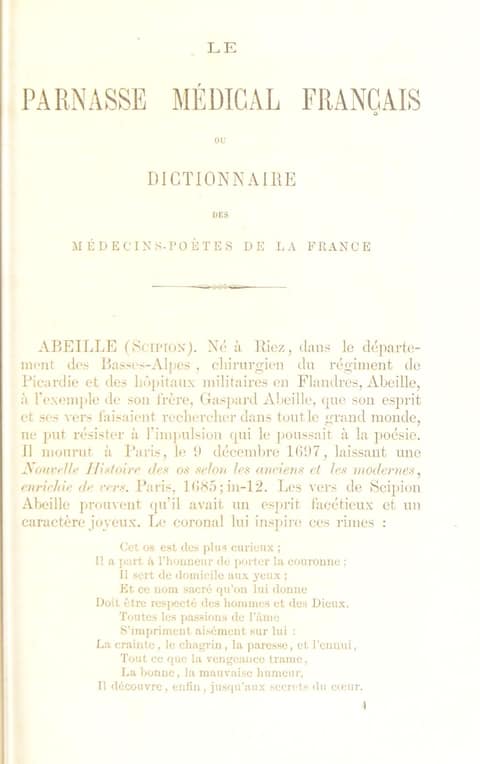
Title page of Le Parnasse médical français
Title page of Le Parnasse médical français , 1874

About this text

Provenance

This digital edition is derived from the Wellcome Collection copy of Achille Chéreau's 1874 dictionary of French physician-poets. The current reader uses the reacquired Wellcome IIIF JPEG corpus as the facsimile source of record.

Methodology

Each page is treated as a page-level unit. The page image remains the authority for the edition. Machine OCR is used as source OCR and reading aid, then corrected into French transcription, then translated into English. Word links connect the English translation to the French transcription and locations on the scans. Fifteen uncertain word-link decisions remain unlinked. Some links highlight only the text because the source word could not be located on the scan.

Rights

The source item is attributed to Wellcome Collection and marked with the Creative Commons Public Domain Mark. Poet Doctor's presentation adds generated transcription, translation, navigation metadata, and editorial context. No access control or anti-bulk-download measure should conflict with the public-domain status of the source material.

Original scans: Wellcome Collection ( Public Domain Mark 1.0 ).

Historian’s note. This text records the medicine of its own time, and later evidence has replaced most of it. It is not medical advice. We read it as history, and we ask what, if anything, connects it to medicine today. More on how we read old medical books