Hover or tap a word to see its match.
Why, joyous temple, why so much sadness!
Why wrap your bell in black crepe?
Take up your sweet accents again, and let mad intoxication,
By means of light refrains, replace the sobs.
Ah! how I pity the one whose misanthropy
Drapes his finest days in long mourning clothes!
Who transforms the spring of his life into winter,
And who thinks of death... which thinks of us always!
To dwell upon one's demise is already to live no more!
Let us sit merrily at the banquet of life!
Let our soul surrender to new raptures,
Let us steal from sorrow even the slightest moment!
Thus I told myself, when, full of youth,
I saw an immense future before me;
I did not understand what old age was,
I believed that time could be held back.
Soon I felt the approaches of mature age,
And the numerous cares constantly reviving;
And when I saw my friends and relatives die,
I then understood the true meaning of nature.
As capricious as she is pitiless,
She breaks in the evening her works of the morning,
And the earth, forever and always insatiable,
Grows rich at her voice with a lugubrious booty.
In vain I invoked the prestige of my past,
And the illusions that make hearts beat,
Time had broken the stem of my happiness,
And my life remained both without fruits and without flowers!
Irrevocably renouncing my profound error,
With regret I learned the sad truth,
That everything which breathes, alas! in this lower world,
Is forever subject to fatality.
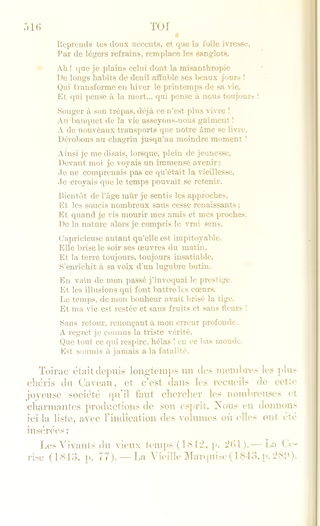
Pourquoi, temple joyeux, pourquoi tant de tristesse !
Pourquoi d'un crêpe noir entourer ton grelot ?
Reprends tes doux accents, et que la folle ivresse,
Par de légers refrains, remplace les sanglots.
Ah ! que je plains celui dont la misanthropie
De longs habits de deuil affuble ses beaux jours !
Qui transforme en hiver le printemps de sa vie,
Et qui pense à la mort... qui pense à nous toujours !
Songer à son trépas, déjà ce n'est plus vivre !
Au banquet de la vie asseyons-nous gaîment !
A de nouveaux transports que notre âme se livre,
Dérobons au chagrin jusqu'au moindre moment !
Ainsi je me disais, lorsque, plein de jeunesse,
Devant moi je voyais un immense avenir;
Je ne comprenais pas ce qu'était la vieillesse,
Je croyais que le temps pouvait se retenir.
Bientôt de l'âge mûr je sentis les approches,
Et les soucis nombreux sans cesse renaissants ;
Et quand je vis mourir mes amis et mes proches,
De la nature alors je compris le vrai sens.
Capricieuse autant qu'elle est impitoyable,
Elle brise le soir ses œuvres du matin,
Et la terre toujours, toujours insatiable,
S'enrichit à sa voix d'un lugubre butin.
En vain de mon passé j'invoquai le prestige,
Et les illusions qui font battre les cœurs,
Le temps, de mon bonheur avait brisé la tige,
Et ma vie est restée et sans fruits et sans fleurs !
Sans retour, renonçant à mon erreur profonde,
A regret je connus la triste vérité,
Que tout ce qui respire, hélas ! en ce bas monde,
Est soumis à jamais à la fatalité.