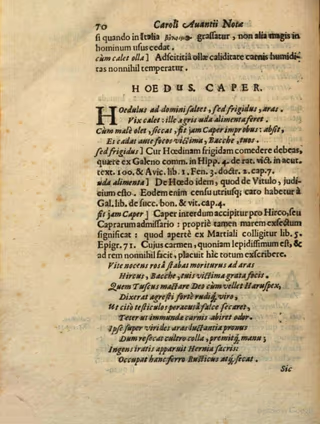
Vite nocens rosâ ſtabat moriturus ad aras

Poet
Martialis
Form
Elegiac couplet
Open the page in the book
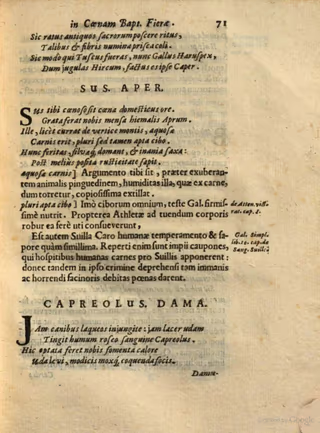
The pages this poem fills. Each opens in the Coena, sive De cibariorum virtutibus reader.

Hover or tap a word to see its match.

Guilty of gnawing the vine, the billy-goat stood about to die at the altars,

O Bacchus, a pleasing victim for your hearths.

When the Tuscan soothsayer wished to sacrifice him to the God,

He had by chance said to a rough countryman,

That he should quickly cut off the testicles with a very sharp sickle,

So that the foul odor of the unclean flesh might depart.

While he himself, leaning forward over the green altars,

Cuts the struggling neck with his knife, and holds it down with his hand;

A huge hernia appeared to the angry sacred rites:

The Countryman seizes this with his blade and cuts it.

Thus believing that the pristine deities demanded the ancient rites of sacrifices,

And were worshipped with such entrails.

Thus you, who had just been a Tuscan haruspex, are now a Gallic haruspex,

While you slaughter the He-goat, you yourself have become a gelded goat.

Vite nocens rosâ ſtabat moriturus ad aras

Hircus, Bacche, tuis victima grata focis.

Quem Tuſcus mactare Deo cùm vellet Haruſpex,

Dixerat agreſti fortè rudiq́; viro,

Ut citò teſticulos peracutâ falce ſecaret,

Teter ut immundæ carnis abiret odor.

Ipſe ſuper virides aras luctantia pronus

Dum reſecat cultro colla, premitq́; manu ;

Ingens iratis apparuit Hernia ſacris:

Occupat hanc ferro Ruſticus atq́; ſecat.

Sic ratus antiquos ſacrorum poſcere ritus,

Talibus & fibris numina priſca coli.

Sic modò qui Tuſcus fueras, nunc Gallus Haruſpex,

Dum jugulas Hircum, factus es ipſe Caper.
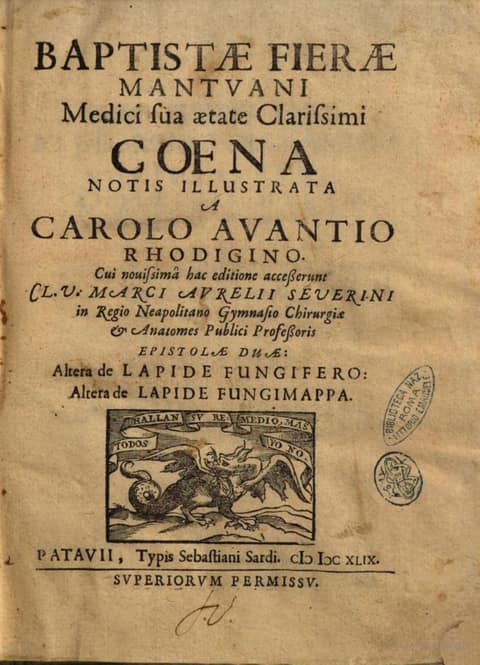
Title page of Coena, sive De cibariorum virtutibus
Title page of Coena, sive De cibariorum virtutibus , 1649

About this text

Provenance

This digital edition is derived from the Internet Archive copy of Battista Fiera's 1649 _Coena, sive De cibariorum virtutibus_, a Latin medical dinner poem with Carlo Avanzi's notes and related material.

Methodology

Each scan is treated as a page-level unit. The page image remains the authority for the edition. Local Kraken OCR used the Reichenau Latin early-print model as a reading aid, then Gemini generated scan-grounded Latin transcription and scholarly English translation from the images, the OCR aid, and the approved glossary. Word links connect the English translation to the Latin transcription and locations on the scans. 32 uncertain word-link decisions remain unlinked. Some links highlight only the text because the source word could not be located on the scan.

Rights

The Internet Archive metadata and IIIF manifest record the digital surrogate under the Creative Commons Public Domain Mark 1.0. Poet Doctor's presentation adds generated OCR, transcription, translation, navigation metadata, and editorial context.

Original scans: Internet Archive / Google Books ( Public Domain Mark 1.0 ).

Historian’s note. This text records the medicine of its own time, and later evidence has replaced most of it. It is not medical advice. We read it as history, and we ask what, if anything, connects it to medicine today. More on how we read old medical books