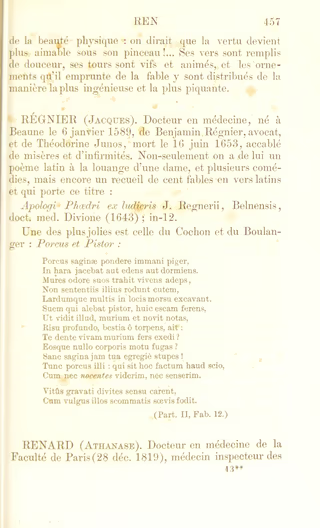
Porcus et Pistor

Poet
Jacques Régnier
Form
Iambic trimeter
Open the page in the book
The page this poem fills. Each opens in the Le Parnasse médical français reader.

Hover or tap a word to see its match.

A pig, sluggish with the immense weight of its fat,

Lay in the sty either eating or sleeping.

Its living fat drew mice by its smell,

They gnaw the skin of the unfeeling beast,

And hollow out its lard with bites in many places.

The baker who fed the swine, bringing it food,

When he saw this, and recognized the marks of the mice,

With a deep laugh, said: "O torpid beast,

Do you allow yourself to be eaten alive by the teeth of mice?

And do you not chase them away with any movement of your body?

Truly you are now extraordinarily stupefied by your fattening!"

Then the pig to him: "How this happened I do not know,

Since I neither saw the culprits, nor felt them."

Weighed down by vices, the rich lack sense,

When the common crowd pierces them with cruel taunts.

Porcus saginæ pondere immani piger,

In hara jacebat aut edens aut dormiens.

Mures odore suos trahit vivens adeps,

Non sententiis illius rodunt cutem,

Lardumque multis in locis morsu excavant.

Suem qui alebat pistor, huic escam ferens,

Ut vidit illud, murium et novit notas,

Risu profundo, bestia ô torpens, ait :

Te dente vivam murium fers exedi ?

Eosque nullo corporis motu fugas ?

Sane sagina jam tua egregiè stupes !

Tunc porcus illi : qui sit hoc factum haud scio,

Cum nec nocentes viderim, nec senserim.

Vitûs gravati divites sensu carent,

Cum vulgus illos scommatis sævis fodit.
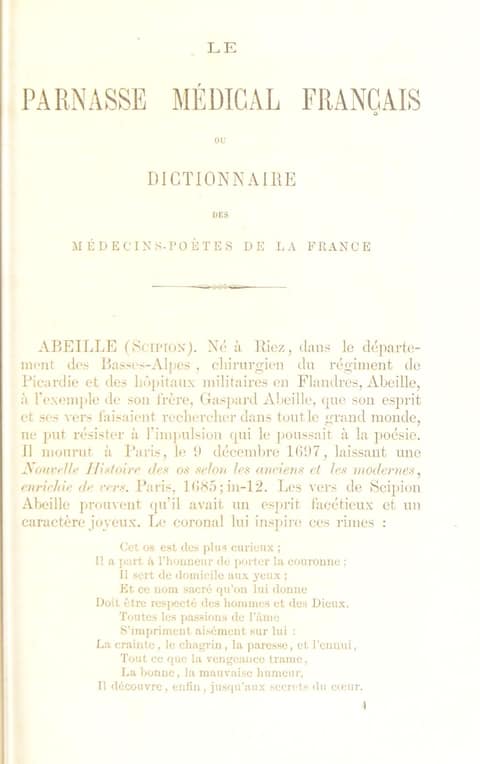
Title page of Le Parnasse médical français
Title page of Le Parnasse médical français , 1874

About this text

Provenance

This digital edition is derived from the Wellcome Collection copy of Achille Chéreau's 1874 dictionary of French physician-poets. The current reader uses the reacquired Wellcome IIIF JPEG corpus as the facsimile source of record.

Methodology

Each page is treated as a page-level unit. The page image remains the authority for the edition. Machine OCR is used as source OCR and reading aid, then corrected into French transcription, then translated into English. Word links connect the English translation to the French transcription and locations on the scans. Fifteen uncertain word-link decisions remain unlinked. Some links highlight only the text because the source word could not be located on the scan.

Rights

The source item is attributed to Wellcome Collection and marked with the Creative Commons Public Domain Mark. Poet Doctor's presentation adds generated transcription, translation, navigation metadata, and editorial context. No access control or anti-bulk-download measure should conflict with the public-domain status of the source material.

Original scans: Wellcome Collection ( Public Domain Mark 1.0 ).

Historian’s note. This text records the medicine of its own time, and later evidence has replaced most of it. It is not medical advice. We read it as history, and we ask what, if anything, connects it to medicine today. More on how we read old medical books