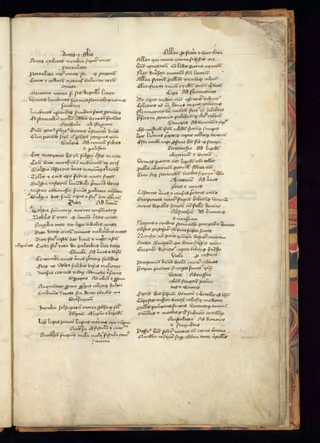
Salgia Ad cruorē febres ⁊ paliſim

Form
Not identifiable from book
Open the page in the book
The page this poem fills. Each opens in the Regimen sanitatis Salernitanum reader.

Hover or tap a word to see its match.

Sage, for trembling, fevers,

and palsy

Why should a man die when sage grows in the garden?

Against the power of death there is no medicine in gardens.

Sage strengthens the sinews and takes away trembling

Of the hands, and by its aid acute fever flees.

Sage, castoreum, lavender, primrose,

Nasturtium, and tansy heal paralytic limbs.

Sage gives a healthy head and makes it beloved.

Cur morietur hō cū salgia c̄stit in orto

Cōū vim mortis nō ē medicamē in ortis

Salgia cōfortat n̄uos maniū t̄morē

Tollit ⁊ eius ope febris acuta fugit

Salgia castoriū lauēdula p̄mula veris

nastur athanasia sanāt ꝑalitica mēbra

Salgia dat sanū caput ⁊ facᵗ hoc adamī
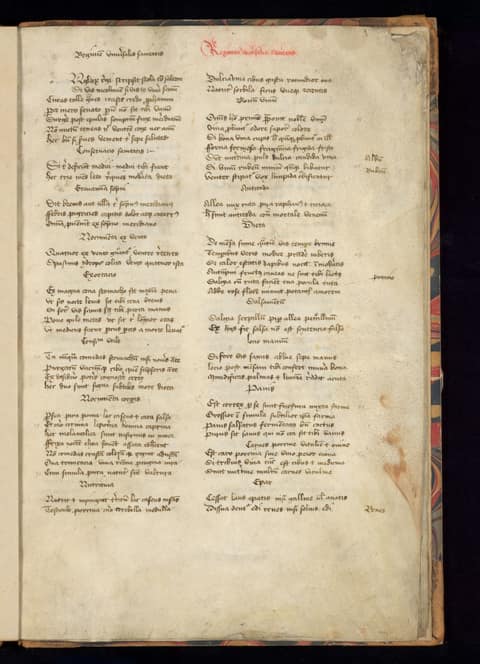
Title page of Regimen sanitatis Salernitanum
Title page of Regimen sanitatis Salernitanum , 1450

About this text

Provenance

This edition uses the Wellcome Collection images of MS 673 (catalogue number b19638425). Scans 1 to 30 show the binding, the flyleaves and the nine leaves. The Regimen fills folios 1r to 7v (scans 7 to 20). The English poems and receipts are on folios 7v to 9r (scans 20 to 23). The Wellcome images of the spine, the edges and the colour chart are not included.

The English additions are in less formal hands, and some letters are rubbed or lost. In the transcription of these pages, [?] marks letters that cannot be read.

Rights

The Wellcome Collection marks the digital images with the Public Domain Mark 1.0. Credit the Wellcome Collection.

Original scans: Wellcome Collection ( Public Domain Mark 1.0 ).

Historian’s note. This text records the medicine of its own time, and later evidence has replaced most of it. It is not medical advice. We read it as history, and we ask what, if anything, connects it to medicine today. More on how we read old medical books