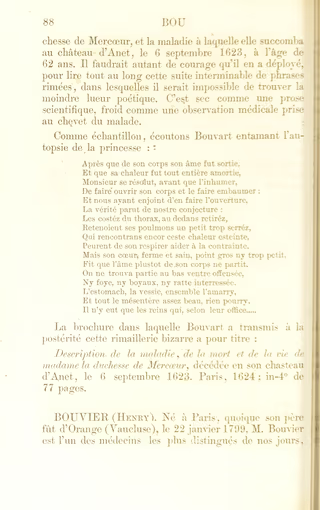
Après que de son corps son âme fut sortie,

Poet
BOUVART
Form
Alexandrin
Open the page in the book
The page this poem fills. Each opens in the Le Parnasse médical français reader.

Hover or tap a word to see its match.

After her soul had departed from her body,

And her heat was entirely spent,

Monsieur resolved, before interring her,

To have her body opened and to have it embalmed;

And having enjoined us to make the opening,

The truth of our conjecture appeared:

The sides of the thorax, retracted inward,

Held her lungs a little too tightly,

Which, still encountering this extinguished heat,

May have aided in the constraint of her breathing.

But her heart, firm and sound, neither large nor too small,

Caused the soul not to depart her body sooner.

No injured part was found in the lower belly,

Nor liver, nor bowels, nor spleen affected.

The stomach, the bladder, together with the womb,

And all the mesentery quite beautiful, nothing rotten.

There were only the kidneys which, according to their office.....

Après que de son corps son âme fut sortie,

Et que sa chaleur fut tout entière amortie,

Monsieur se résolut, avant que l'inhumer,

De faire ouvrir son corps et le faire embaumer ;

Et nous ayant enjoint d'en faire l'ouverture,

La vérité parut de nostre conjecture :

Les costéz du thorax, au dedans retirez,

Retenoient ses poulmons un petit trop serréz,

Qui rencontrans encor ceste chaleur esteinte,

Peurent de son respirer aider à la contrainte.

Mais son cœur, ferme et sain, point gros ny trop petit,

Fit que l'âme plustot de son corps ne partit.

On ne trouva partie au bas ventre offensée,

Ny foye, ny boyaux, ny ratte interressée.

L'estomach, la vessie, ensemble l'amarry,

Et tout le mésentère assez beau, rien pourry.

Il n'y eut que les reins qui, selon leur office.....
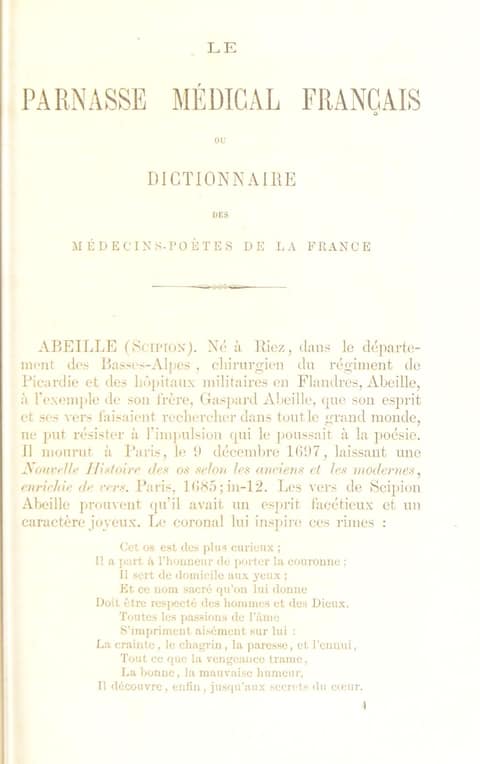
Title page of Le Parnasse médical français
Title page of Le Parnasse médical français , 1874

About this text

Provenance

This digital edition is derived from the Wellcome Collection copy of Achille Chéreau's 1874 dictionary of French physician-poets. The current reader uses the reacquired Wellcome IIIF JPEG corpus as the facsimile source of record.

Methodology

Each page is treated as a page-level unit. The page image remains the authority for the edition. Machine OCR is used as source OCR and reading aid, then corrected into French transcription, then translated into English. Word links connect the English translation to the French transcription and locations on the scans. Fifteen uncertain word-link decisions remain unlinked. Some links highlight only the text because the source word could not be located on the scan.

Rights

The source item is attributed to Wellcome Collection and marked with the Creative Commons Public Domain Mark. Poet Doctor's presentation adds generated transcription, translation, navigation metadata, and editorial context. No access control or anti-bulk-download measure should conflict with the public-domain status of the source material.

Original scans: Wellcome Collection ( Public Domain Mark 1.0 ).

Historian’s note. This text records the medicine of its own time, and later evidence has replaced most of it. It is not medical advice. We read it as history, and we ask what, if anything, connects it to medicine today. More on how we read old medical books