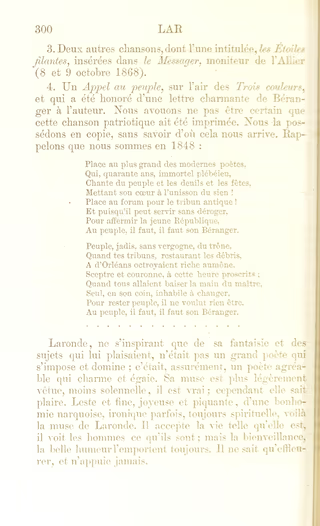
Appel au peuple

Poet
Charles Laronde
Form
Decasyllable
Open the page in the book
The page this poem fills. Each opens in the Le Parnasse médical français reader.

Hover or tap a word to see its match.

Make way for the greatest of modern poets,

Who, for forty years, an immortal plebeian,

Sings of the people's sorrows and their feasts,

Putting his heart in unison with theirs!

Make way in the forum for the ancient tribune!

And since he can serve without stooping,

To strengthen the young Republic,

The people need, they need their Béranger.

People, formerly, shamelessly, of the throne,

When your tribunes, restoring the ruins,

Granted to d'Orléans a rich alms,

Scepter and crown, at this hour proscribed;

When all went to kiss the master's hand,

Alone, in his corner, incapable of changing,

To remain of the people, he wished to be nothing.

The people need, they need their Béranger.

Place au plus grand des modernes poètes,

Qui, quarante ans, immortel plébéien,

Chante du peuple et les deuils et les fêtes,

Mettant son cœur à l'unisson du sien !

Place au forum pour le tribun antique !

Et puisqu'il peut servir sans déroger,

Pour affermir la jeune République,

Au peuple, il faut, il faut son Béranger.

Peuple, jadis, sans vergogne, du trône,

Quand tes tribuns, restaurant les débris,

A d'Orléans octroyaient riche aumône,

Sceptre et couronne, à cette heure proscrits ;

Quand tous allaient baiser la main du maître,

Seul, en son coin, inhabile à changer,

Pour rester peuple, il ne voulut rien être.

Au peuple, il faut, il faut son Béranger.
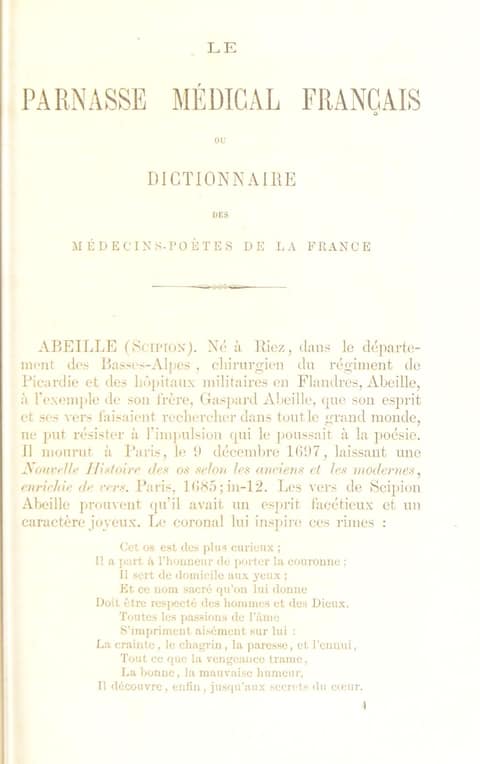
Title page of Le Parnasse médical français
Title page of Le Parnasse médical français , 1874

About this text

Provenance

This digital edition is derived from the Wellcome Collection copy of Achille Chéreau's 1874 dictionary of French physician-poets. The current reader uses the reacquired Wellcome IIIF JPEG corpus as the facsimile source of record.

Methodology

Each page is treated as a page-level unit. The page image remains the authority for the edition. Machine OCR is used as source OCR and reading aid, then corrected into French transcription, then translated into English. Word links connect the English translation to the French transcription and locations on the scans. Fifteen uncertain word-link decisions remain unlinked. Some links highlight only the text because the source word could not be located on the scan.

Rights

The source item is attributed to Wellcome Collection and marked with the Creative Commons Public Domain Mark. Poet Doctor's presentation adds generated transcription, translation, navigation metadata, and editorial context. No access control or anti-bulk-download measure should conflict with the public-domain status of the source material.

Original scans: Wellcome Collection ( Public Domain Mark 1.0 ).

Historian’s note. This text records the medicine of its own time, and later evidence has replaced most of it. It is not medical advice. We read it as history, and we ask what, if anything, connects it to medicine today. More on how we read old medical books