Hover or tap a word to see its match.
Consoling angel! Spirit of love! O woman!
Heaven is your empire, and its power your flame.
You lived in the bosom of the Creator Being,
Who conceived your genius and composed your heart.
By the tedium of his days, by his vague suffering,
By his sadness, Adam recognized your absence.
But God reserved you for his final blessing.
Without you, would paradise have been perfect?
Without the hope of being loved, without this supreme happiness,
Which makes us cherish our days to please the one we love,
Which confines existence to the beatings of the heart,
The world is without pleasures, withered by sorrow;
To the heart everything is heavy, to the eye everything seems dark,
Life is a hell whose shadow nothing softens;
We shudder at the sight of the simplest desires,
We fall out of love with ourselves, we flee even our memories,
We take fright, we blame a gentle weakness;
In the end we lose interest in ourselves,
We also grow weary of the burden of our days,
We call for death, it always flees from you;
Nothing outside, nothing within us, can awaken our desire,
Love is the only knot that binds us to life!
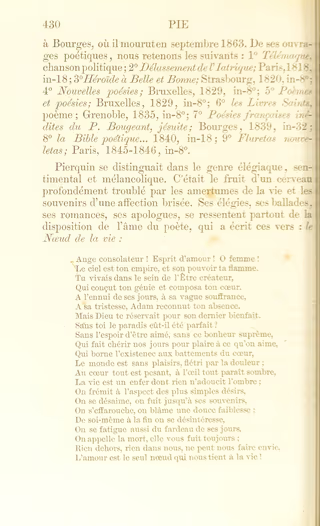
Ange consolateur ! Esprit d'amour ! O femme !
Le ciel est ton empire, et son pouvoir ta flamme.
Tu vivais dans le sein de l'Être créateur,
Qui conçut ton génie et composa ton cœur.
A l'ennui de ses jours, à sa vague souffrance,
A sa tristesse, Adam reconnut ton absence.
Mais Dieu te réservait pour son dernier bienfait.
Sans toi le paradis eût-il été parfait ?
Sans l'espoir d'être aimé, sans ce bonheur suprême,
Qui fait chérir nos jours pour plaire à ce qu'on aime,
Qui borne l'existence aux battements du cœur,
Le monde est sans plaisirs, flétri par la douleur ;
Au cœur tout est pesant, à l'œil tout paraît sombre,
La vie est un enfer dont rien n'adoucit l'ombre ;
On frémit à l'aspect des plus simples désirs,
On se désaime, on fuit jusqu'à ses souvenirs,
On s'effarouche, on blâme une douce faiblesse ;
De soi-même à la fin on se désintéresse,
On se fatigue aussi du fardeau de ses jours,
On appelle la mort, elle vous fuit toujours ;
Rien dehors, rien dans nous, ne peut nous faire envie,
L'amour est le seul nœud qui nous tient à la vie !