Hover or tap a word to see its match.
"What one chemist has done, another undoes;
Let us see if his art will establish the fact."
They believe my passport to be that of a brother.
— Why not, I said, that of my grandfather?
I was seen, one maintains, sketching in pencil
Ditch, glacis, redan, scarp, and bastion.
In vain they seek its image on my tablet.
From the police station they lead me to the chief;
There they count my purse, where, I will say that in short,
The sum of fourteen hundred francs still remained.
After this examination at the town hall,
A militia corps leads me to my hotel,
Walking around me, a policeman,
Pushing back the crowd with its shrill threats.
My valise is searched and my clothes are probed.
No corpus delicti is discovered there.
Once again I am taken to the police station,
Where a report on the searches is made to the magistrate.
He is handed a book, in the form of a brochure,
On the back of which his eye reads the list
Of my works in verse, written in French,
Containing roughly thirty thousand meters.
He even reads a page of the text. Neither Goethe,
Nor any other poet of Germania
Would have written so correctly in my language.
And nothing of the German idiom was found there.
While they deliberate
Whether I shall be judged by a court-martial,
Through the town they parade and show my portrait,
Made by a pupil of Daguerre and Niepce.
Nosnoblet, of Arenthon, happening to pass by,
At the sight of the image of the alleged Prussian:
"Oh! it's," he says, surprised, "Monsieur Andrevetan,
My doctor at La Roche, and I am very pleased with him."
And without the formality of an official report,
I leave Besançon, set at liberty.
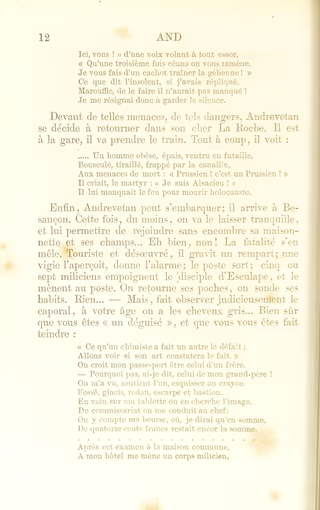
« Ce qu'un chimiste a fait un autre le défait ;
Allons voir si son art constatera le fait. »
On croit mon passe-port être celui d'un frère.
— Pourquoi pas, ai-je dit, celui de mon grand-père ?
On m'a vu, soutient l'un, esquisser au crayon
Fossé, glacis, redan, escarpe et bastion.
En vain sur ma tablette on en cherche l'image.
Du commissariat on me conduit au chef;
On y compte ma bourse, où, je dirai qu'en somme,
De quatorze cents francs restait encor la somme.
Après cet examen à la maison commune,
A mon hôtel me mène un corps milicien,
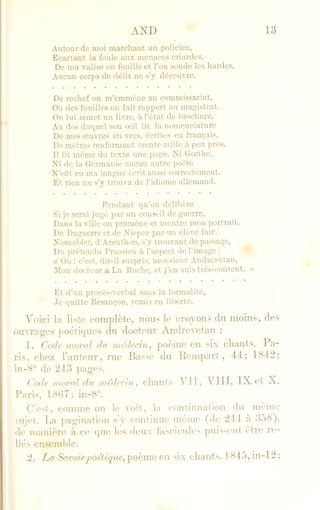
Autour de moi marchant un policien,
Ecartant la foule aux menaces criardes.
De ma valise on fouille et l'on sonde les hardes.
Aucun corps de délit ne s'y découvre.
De rechef on m'emmène au commissariat,
Où des fouilles on fait rapport au magistrat.
On lui remet un livre, à l'état de brochure,
Au dos duquel son œil lit la nomenclature
De mes œuvres en vers, écrites en français,
De mètres renfermant trente mille à peu près.
Il lit même du texte une page. Ni Gœthe,
Ni de la Germanie aucun autre poëte
N'eût en ma langue écrit aussi correctement.
Et rien ne s'y trouva de l'idiome allemand.
Pendant qu'on délibère
Si je serai jugé par un conseil de guerre,
Dans la ville on promène et montre mon portrait,
De Daguerre et de Niepce par un élève fait.
Nosnoblet, d'Arenthon, s'y trouvant de passage,
Du prétendu Prussien à l'aspect de l'image :
« Oh ! c'est, dit-il surpris, monsieur Andrevetan,
Mon docteur à La Roche, et j'en suis très-content. »
Et d'un procès-verbal sans la formalité,
Je quitte Besançon, remis en liberté.