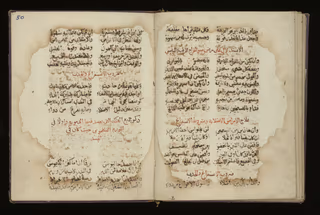
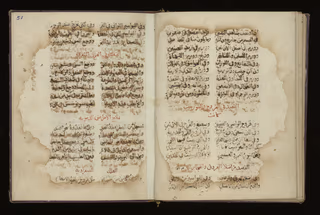
ذكر جميع العلل التي يقصد فيها الدمويه واولا في الورم الفلغموني حيث كان في الجسد

Poet
Ibn Sina
Form
Rajaz
Open the page in the book
The pages this poem fills. Each opens in the Ibn Sina's Urjuza fi al-tibb and other medical works in MS Arabic 129 reader.

Hover or tap a word to see its match.

And Galen only phlebotomizes / a vein whenever the chyme is abundant.

If he sees a sign of blood / in the body, especially from a swelling.

So phlebotomize if evacuation avails it, / and [for] the rest of the humors.

And phlebotomize for this task whatever is phlebotomized / of the diseases, from what is phlebotomized.

If you are confident in the evidence of the pulse / then begin by letting blood from every intended [site]

In the body, from the outside or from the inside / and whatever of it is in the joints

And swelling below the ears / and swelling in ophthalmia of the eyes

And swelling of the tongue and the gums / and angina and swelling of the uvula

And in the salivary glands and in the tonsils / and in quinsies and in the glands

Likewise pleurisy and pneumonia / and swelling in the breast and the groin

And swelling in the liver or in the stomach / and swelling of the intestines and in the anus

And in the spleen and in the testicles / and in the bladder and in the two kidneys

And swelling of the womb or in the navel / and the popliteal space and from the vessels of erysipelas

وانما يقصد جالينوس / عرقا اذا ما كثر الكيموس

اذ رأى علامة من الدم / في البدن لاسيما من ورم

فاقصد ان يجده الاستفراغ / وبية لساير الاخلاط

واقصد لهذا الشغل ايما يقصد / من الامراض مما قد يقصد

إذا وثقت بشاهد النبضِ / فابدأ بفصد كل مقصودِ

في الجسم من خارج أو من داخل / وما يكون منه في المفاصل

وورم في اسفل الاذنين / وورم في رمد العينين

وورم اللسان واللثاة / وذبح وورم اللهاة

وفي النغانغ وفي اللوزات / وفي الخوانيق وفي الغدات

كذاك جنب وذات رية / وورم في الثدي والاربية

وورم في الكبد أو في المعدة / وورم الامعاء وفي المقعدة

وفي الطحال وفي الانثيين / وفي مثانة وفي كليتين

وورم الرحم أو في السُّرة / والمأبضه ومن عروق الحمرة
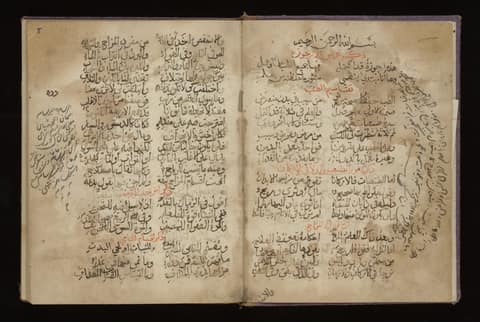
Title page of Ibn Sina's Urjuza fi al-tibb and other medical works in MS Arabic 129
Title page of Ibn Sina's Urjuza fi al-tibb and other medical works in MS Arabic 129 , 1700

About this text

Provenance

MS Arabic 129 is a handwritten Arabic medical volume held by Wellcome Collection in London. It is a composite manuscript: a single volume that brings together 11 separate works. They cover bloodletting, circumcision, the seasons, anatomy, the pulse, and urine, and most are in verse. Most of the verse in this edition is Ibn Sina's Urjuza fi al-tibb, a long poem on medicine, identified from the catalog card in the scans and from the poem's opening lines. Wellcome also names Ibn al-Tilmidh and Ibn Makki among the authors. Shams al-Din ibn Makki wrote three short poems here, and some pieces cannot be identified from the book. The manuscript is undated, and Wellcome estimates it as 18th century.

Methodology

Each scan is treated as a page-level unit. The page image remains the authority for the edition. Local Arabic Kraken OCR was weak and used only as auxiliary context; Gemini generated scan-grounded Arabic transcription and English translation primarily from the manuscript images and the approved glossary. Some word links remain uncertain, and some words have no reliable location on the scan.

Rights

The Wellcome Collection source record marks the digital surrogate with the Public Domain Mark 1.0. Poet Doctor's presentation adds generated OCR, transcription, translation, navigation metadata, and editorial context.

Original scans: Wellcome Collection ( Public Domain Mark 1.0 ).

Historian’s note. This text records the medicine of its own time, and later evidence has replaced most of it. It is not medical advice. We read it as history, and we ask what, if anything, connects it to medicine today. More on how we read old medical books