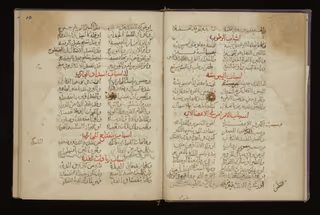
Causes of blockage of the passages

اسباب انسداد المجاري

Poet
Ibn Sina
Form
Rajaz
Open the page in the book
The page this poem fills. Each opens in the Ibn Sina's Urjuza fi al-tibb and other medical works in MS Arabic 129 reader.

Hover or tap a word to see its match.

And the genus of what blocks the passages is general / I have tired my thoughts in gathering them:

Strength of retention and weakness of an expeller / and cold may constrict the junctions

And dryness, as it constricts them with its excess / and blockages, it may gather them by its pressure

And a tumor that presses, and twisting / and a constricting medicine may squeeze

And the healing of an ulcer, and a wart / and flesh if it increases without limit

And humor, and pus, and blood / and a pimple that is knotted, and water

And the fetus, and worms, and stones / or hard feces, and air

وجنس ما يسد المجاري يعم / اتعبت في تجمعها افكاري

شدة امساك وضعف دافع / والبرد قد يقبض للمجامع

واليبس اذ يقبضها بفرطه / والسدد فجمعها بضغطه

وورم يضغط والتواء / وقد يضم القابض الدواء

والتحام القرح والتالول / واللحم ان زاد بلا تحصيل

والخلط والمدة والدماء / والبثر منعقد ومازا

ولحم والديدان والحصاء / او البراز الصلب والهواء
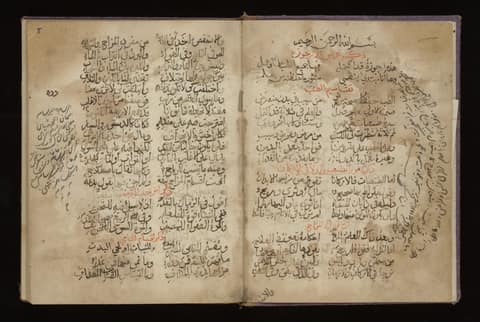
Title page of Ibn Sina's Urjuza fi al-tibb and other medical works in MS Arabic 129
Title page of Ibn Sina's Urjuza fi al-tibb and other medical works in MS Arabic 129 , 1700

About this text

Provenance

MS Arabic 129 is a handwritten Arabic medical volume held by Wellcome Collection in London. It is a composite manuscript: a single volume that brings together 11 separate works. They cover bloodletting, circumcision, the seasons, anatomy, the pulse, and urine, and most are in verse. Most of the verse in this edition is Ibn Sina's Urjuza fi al-tibb, a long poem on medicine, identified from the catalog card in the scans and from the poem's opening lines. Wellcome also names Ibn al-Tilmidh and Ibn Makki among the authors. Shams al-Din ibn Makki wrote three short poems here, and some pieces cannot be identified from the book. The manuscript is undated, and Wellcome estimates it as 18th century.

Methodology

Each scan is treated as a page-level unit. The page image remains the authority for the edition. Local Arabic Kraken OCR was weak and used only as auxiliary context; Gemini generated scan-grounded Arabic transcription and English translation primarily from the manuscript images and the approved glossary. Some word links remain uncertain, and some words have no reliable location on the scan.

Rights

The Wellcome Collection source record marks the digital surrogate with the Public Domain Mark 1.0. Poet Doctor's presentation adds generated OCR, transcription, translation, navigation metadata, and editorial context.

Original scans: Wellcome Collection ( Public Domain Mark 1.0 ).

Historian’s note. This text records the medicine of its own time, and later evidence has replaced most of it. It is not medical advice. We read it as history, and we ask what, if anything, connects it to medicine today. More on how we read old medical books