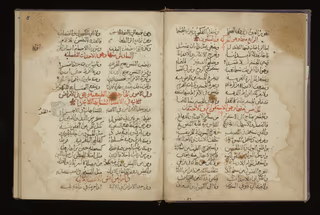
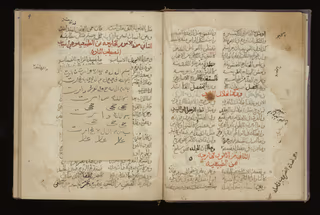
Mention of the diseases of the instrumental organs

ذكر امراض الاعضا الاليه

Poet
Ibn Sina
Form
Rajaz
Open the page in the book
The pages this poem fills. Each opens in the Ibn Sina's Urjuza fi al-tibb and other medical works in MS Arabic 129 reader.

Hover or tap a word to see its match.

And whoever finds diseases in the instrumental [organs] / when an affliction occurs in its creation.

Or like a large stature / And a decrease is like a small stomach

And shape, if it causes an error in the matter / You see the shape of the head from it like a basket

Likewise, if an illness occurs in the cavity / Then the sole of the foot becomes filled with flesh

And if something occurs devoid of passages / Like a blockage in the kidneys from stones

And what needs roughness becomes smooth / Like a stomach with excessive softness

And what needs smoothness becomes rough / Like the throat afflicted by dryness

And the quantity departs from its natures / Like six or four fingers

And perhaps two fingers are joined together / And perhaps the jaws are separated

ومن يجد الامراض في الاليه / اذا جرت في خلقه بليه

او مثل القامة الكبيرة / والنقص مثل المعدة الصغيرة

والشكل ان اوقع في الامر غلط / رايت شكل الراس منه كالسطط

كذا وفي التجويف ان جرا سقم / فممتلي باللحم باطن القدم

وان جرى لشيء عاريا لمجاري / كالسد في الكلى من الاحجار

وملمس المحتاج للخشونة / كمدة مفرطة اللدونة

وخشن المحتاج للملاسة / كالحلق يعتري يبوسه

ومخرج المقدار عن طبائعه / كالستة او كالاربع الاصابع

وربما اتصل اصبعان في / وربما المنفصل الفكان
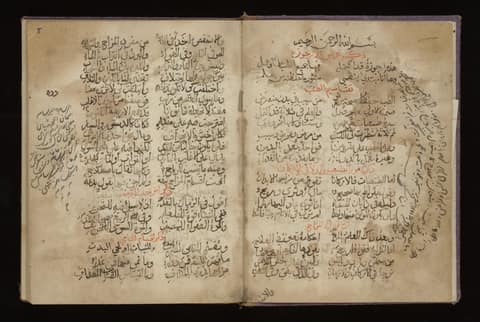
Title page of Ibn Sina's Urjuza fi al-tibb and other medical works in MS Arabic 129
Title page of Ibn Sina's Urjuza fi al-tibb and other medical works in MS Arabic 129 , 1700

About this text

Provenance

MS Arabic 129 is a handwritten Arabic medical volume held by Wellcome Collection in London. It is a composite manuscript: a single volume that brings together 11 separate works. They cover bloodletting, circumcision, the seasons, anatomy, the pulse, and urine, and most are in verse. Most of the verse in this edition is Ibn Sina's Urjuza fi al-tibb, a long poem on medicine, identified from the catalog card in the scans and from the poem's opening lines. Wellcome also names Ibn al-Tilmidh and Ibn Makki among the authors. Shams al-Din ibn Makki wrote three short poems here, and some pieces cannot be identified from the book. The manuscript is undated, and Wellcome estimates it as 18th century.

Methodology

Each scan is treated as a page-level unit. The page image remains the authority for the edition. Local Arabic Kraken OCR was weak and used only as auxiliary context; Gemini generated scan-grounded Arabic transcription and English translation primarily from the manuscript images and the approved glossary. Some word links remain uncertain, and some words have no reliable location on the scan.

Rights

The Wellcome Collection source record marks the digital surrogate with the Public Domain Mark 1.0. Poet Doctor's presentation adds generated OCR, transcription, translation, navigation metadata, and editorial context.

Original scans: Wellcome Collection ( Public Domain Mark 1.0 ).

Historian’s note. This text records the medicine of its own time, and later evidence has replaced most of it. It is not medical advice. We read it as history, and we ask what, if anything, connects it to medicine today. More on how we read old medical books