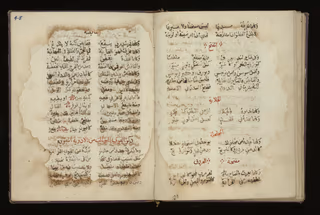
The page this poem fills. Each opens in the Ibn Sina's Urjuza fi al-tibb and other medical works in MS Arabic 129 reader.

Hover or tap a word to see its match.

Whatever blocks a vein is beneficial, / it is an astringent, but it does not sting.

Whatever burns is the utmost / in heat, and thick in the extreme.

And whatever you find to putrefy, / is excessively hot, attenuating, and soft.

That which breaks down flesh is in this category, / as is the cicatrizant of a wound, which dries it.

And whatever is specific for attracting the replete, / is like the bezoar and the purgative drug.

And everything attracts by a quality, / with every [substance] possessing heat and attenuation,

By its nature, like wormwood and bdellium, / and by putrefaction, like dung.

And the bezoar is overpowering in its benefit, / by its essence or by its nature.

And from it is that which benefits through purgation, / or attains the power of the theriac.

And taking it in health is harmful; / therefore, by specific property, it may alter.

And that which removes pain is a sedative, / an incisive, attenuating, and anesthetizing [drug].

And among them is the narcotic that is beneficial, / like opium with henbane, whose sleep occurs.

وكلما يسد عرقا ينفع / فقابض لكنه لا يلذع

وكلما يحرق فهو الغاية / في الحر والغلظ في النهاية

وكلما تجده يعفن / فمفرط الحر لطيف لين

والناقض اللحم ففي ذا الصنفة / ومدمّل الجرح الذي يجففه

وكلما خص بجذب الممتلى / كالبادزهر والدواء المسهل

وكل شي جذبه بكيف / بكل ذي حرارة ولطف

بطبعه كالشيح ومقل / وبالعفونة كمثل الزبل

والبادزهر قاهر في نفعه / بكينونته او بطبعه

ومنه ما ينفع بالاسهال / او ينال قوة الترياق

واخذه في صحة يضر / لذاك بالمحاجم قد يغير

وما يزيل وجعا مسكن / مقطع ملطف مبنج

ومنه بالمخدر ما قد ينفع / كافيون ببنج منامه يقع
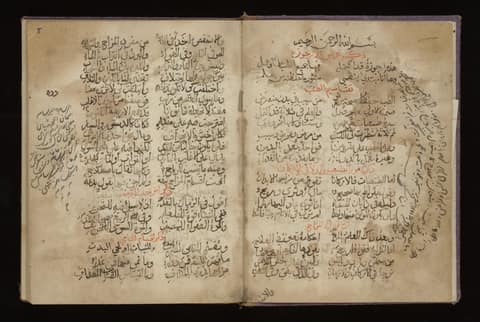
Title page of Ibn Sina's Urjuza fi al-tibb and other medical works in MS Arabic 129
Title page of Ibn Sina's Urjuza fi al-tibb and other medical works in MS Arabic 129 , 1700

About this text

Provenance

MS Arabic 129 is a handwritten Arabic medical volume held by Wellcome Collection in London. It is a composite manuscript: a single volume that brings together 11 separate works. They cover bloodletting, circumcision, the seasons, anatomy, the pulse, and urine, and most are in verse. Most of the verse in this edition is Ibn Sina's Urjuza fi al-tibb, a long poem on medicine, identified from the catalog card in the scans and from the poem's opening lines. Wellcome also names Ibn al-Tilmidh and Ibn Makki among the authors. Shams al-Din ibn Makki wrote three short poems here, and some pieces cannot be identified from the book. The manuscript is undated, and Wellcome estimates it as 18th century.

Methodology

Each scan is treated as a page-level unit. The page image remains the authority for the edition. Local Arabic Kraken OCR was weak and used only as auxiliary context; Gemini generated scan-grounded Arabic transcription and English translation primarily from the manuscript images and the approved glossary. Some word links remain uncertain, and some words have no reliable location on the scan.

Rights

The Wellcome Collection source record marks the digital surrogate with the Public Domain Mark 1.0. Poet Doctor's presentation adds generated OCR, transcription, translation, navigation metadata, and editorial context.

Original scans: Wellcome Collection ( Public Domain Mark 1.0 ).

Historian’s note. This text records the medicine of its own time, and later evidence has replaced most of it. It is not medical advice. We read it as history, and we ask what, if anything, connects it to medicine today. More on how we read old medical books