Hover or tap a word to see its match.
Loire, O charming river, whose tranquil waves
Reflect in their course the image of a hundred cities,
On your fortunate banks how green are the groves!
How the laughing gardens are covered with sweet fruits!
How many vines shine on the flanks of your mountains!
How many golden ears of wheat crown your countryside!
And the scythe of battle, spreading its furies,
Has severed, all at once, your harvests and your flowers!
Your frightened birds have fled from their woodlands;
Your stricken bulls have died in the pastures;
The cannonballs, in your fields, have dug tombs;
And mutilated bodies have rolled in your waters.
The mildness of your sky, your splendid abundance,
Made of your valleys the orchard of France.
But your waters today, trembling with our mourning,
Bathe, in passing, only the foot of the coffins.
It will take long days for your plaintive waves
To wash away the blood that sullies your two banks:
You will not erase the cruel memory
Of the ills the Teutons have made us suffer,
You will not erase the tears of France,
And the eternal oath of a just vengeance.
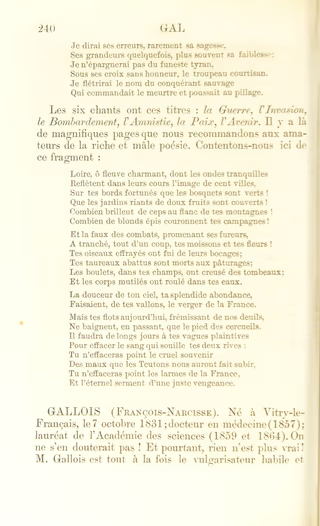
Loire, ô fleuve charmant, dont les ondes tranquilles
Reflètent dans leurs cours l'image de cent villes,
Sur tes bords fortunés que les bosquets sont verts !
Que les jardins riants de doux fruits sont couverts !
Combien brillent de ceps au flanc de tes montagnes !
Combien de blonds épis couronnent tes campagnes !
Et la faux des combats, promenant ses fureurs,
A tranché, tout d'un coup, tes moissons et tes fleurs !
Tes oiseaux effrayés ont fui de leurs bocages;
Tes taureaux abattus sont morts aux pâturages;
Les boulets, dans tes champs, ont creusé des tombeaux;
Et les corps mutilés ont roulé dans tes eaux.
La douceur de ton ciel, ta splendide abondance,
Faisaient, de tes vallons, le verger de la France.
Mais tes flots aujourd'hui, frémissant de nos deuils,
Ne baignent, en passant, que le pied des cercueils.
Il faudra de longs jours à tes vagues plaintives
Pour effacer le sang qui souille tes deux rives :
Tu n'effaceras point le cruel souvenir
Des maux que les Teutons nous auront fait subir,
Tu n'effaceras point les larmes de la France,
Et l'éternel serment d'une juste vengeance.