Hover or tap a word to see its match.
What! you think, my friend, that I must break my lyre,
Rather than sing when my heart inspires me!
You believe that Parnassus is so arduous
That I cannot climb it, that it is forbidden fruit;
And, if I cannot raise myself to the summit,
That I must retreat, or else that I must stop!
But, before the peak, one finds steps;
He who does not reach the top may arrive nearby.
Why then, if the verse comes ready-made beneath my pen,
When the iron is hot and placed upon the anvil,
Should I not strike with a vigorous effort,
To shatter this luminous block into fragments?
Through well-chosen, deeply felt words, the mind shines;
Through well-crafted verses, the light sparkles,
And each flash makes gleam before the eyes of the universe
Reason and sense embellished by these verses.
What does it matter whether I write in verse or else in prose,
If I achieve my ends, when I intend
To be useful above all? — Now, such was the object
That made me take up and treat my subject.
I well know that today, in the world, people prefer
A factual book to the chords of Apollo,
And that sentiment is nothing more than a chimera,
From the moment the stock exchange invades the drawing room,
As soon as thought is discounted by its yield.
But I hold this senseless error in contempt;
We live by the heart as much as by the senses:
Woe to him who is not sensitive to its accents.
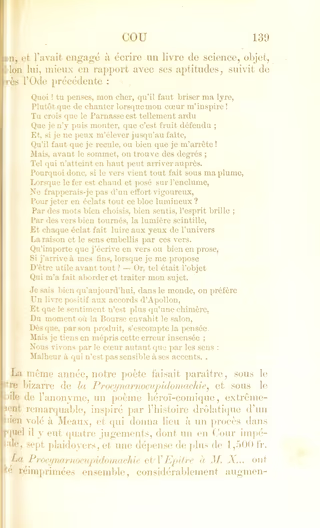
Quoi ! tu penses, mon cher, qu'il faut briser ma lyre,
Plutôt que de chanter lorsque mon cœur m'inspire !
Tu crois que le Parnasse est tellement ardu
Que je n'y puis monter, que c'est fruit défendu ;
Et, si je ne peux m'élever jusqu'au faîte,
Qu'il faut que je recule, ou bien que je m'arrête !
Mais, avant le sommet, on trouve des degrés ;
Tel qui n'atteint en haut peut arriver auprès.
Pourquoi donc, si le vers vient tout fait sous ma plume,
Lorsque le fer est chaud et posé sur l'enclume,
Ne frapperais-je pas d'un effort vigoureux,
Pour jeter en éclats tout ce bloc lumineux ?
Par des mots bien choisis, bien sentis, l'esprit brille ;
Par des vers bien tournés, la lumière scintille,
Et chaque éclat fait luire aux yeux de l'univers
La raison et le sens embellis par ces vers.
Qu'importe que j'écrive en vers ou bien en prose,
Si j'arrive à mes fins, lorsque je me propose
D'être utile avant tout ? — Or, tel était l'objet
Qui m'a fait aborder et traiter mon sujet.
Je sais bien qu'aujourd'hui, dans le monde, on préfère
Un livre positif aux accords d'Apollon,
Et que le sentiment n'est plus qu'une chimère,
Du moment où la Bourse envahit le salon,
Dès que, par son produit, s'escompte la pensée.
Mais je tiens en mépris cette erreur insensée ;
Nous vivons par le cœur autant que par les sens :
Malheur à qui n'est pas sensible à ses accents.