Hover or tap a word to see its match.
You who were seen of old, noble lover of glory,
Marching with Napoleon to victory,
Braving either death or the insult of chains,
Conquering the universe with Napoleon,
Harispe! now weary of our wars,
You pass your solitary hours as a hero;
You live, faithful warrior, in the bosom of friendship,
Separated from the crowd and not forgotten.
However, an eternal and frozen image
Incessantly occupies your sublime thought.
Of the tyrant who is no more, the sinister future
Fills your memory with a salutary dread.
You saw it: the belated justice of the Most High
Struck the guilty one, ordained his punishment;
From the list of kings his great name rejected
Expiates in his exile what he has deserved.
Believe me, Harispe, in the heart of your charming retreat,
Never regret the splendor of the city;
And if liberty does not call you to battles,
Await there the moment appointed for your passing.
The beauty of its sky, the perfume of its roses,
Which the evening zephyr sways half-closed;
The gothic village, where vice never
Dares not disturb the peace of an agricultural people;
These festivals consecrated to the praises of God,
Sacred habits of different ages;
The enchanting idiom spoken in these parts:
What ravishing objects for a generous heart!
There you will live happy; there, lying in the shade,
The morning songster will offer you its homage;
And while the Nive, with its winding turns,
As pure as its waters, will see your days flow by,
I, faithful to the concerts that glory inspires in me,
To celebrate your name, will string my lyre.
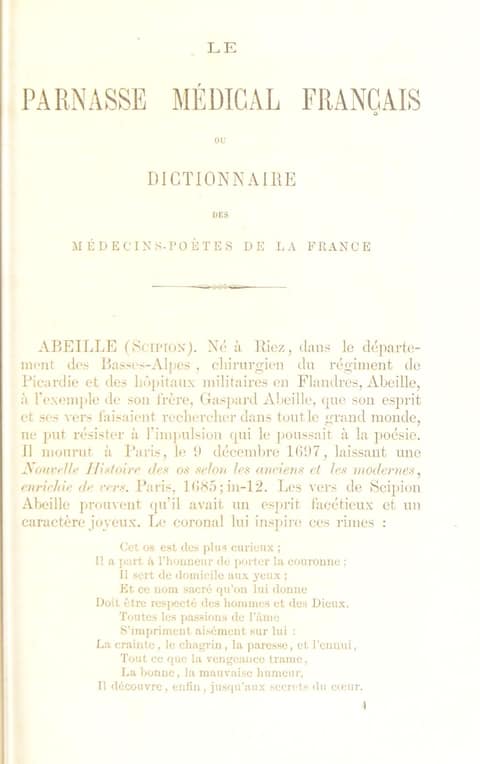
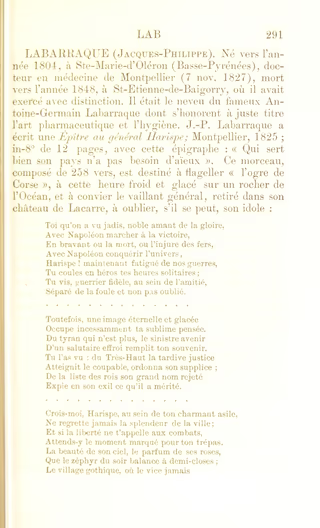
Toi qu'on a vu jadis, noble amant de la gloire,
Avec Napoléon marcher à la victoire,
En bravant ou la mort, ou l'injure des fers,
Avec Napoléon conquérir l'univers,
Harispe ! maintenant fatigué de nos guerres,
Tu coules en héros tes heures solitaires ;
Tu vis, guerrier fidèle, au sein de l'amitié,
Séparé de la foule et non pas oublié.
Toutefois, une image éternelle et glacée
Occupe incessamment ta sublime pensée.
Du tyran qui n'est plus, le sinistre avenir
D'un salutaire effroi remplit ton souvenir.
Tu l'as vu : du Très-Haut la tardive justice
Atteignit le coupable, ordonna son supplice ;
De la liste des rois son grand nom rejeté
Expie en son exil ce qu'il a mérité.
Crois-moi, Harispe, au sein de ton charmant asile,
Ne regrette jamais la splendeur de la ville ;
Et si la liberté ne t'appelle aux combats,
Attends-y le moment marqué pour ton trépas.
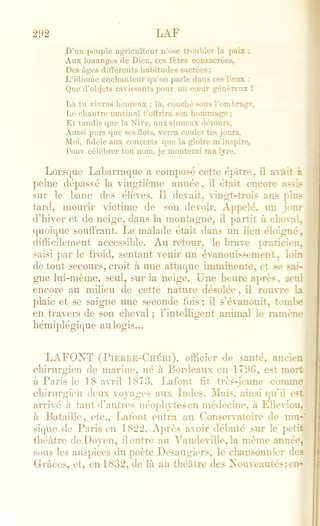
La beauté de son ciel, le parfum de ses roses,
Que le zéphyr du soir balance à demi-closes ;
Le village gothique, où le vice jamais
D'un peuple agriculteur n'ose troubler la paix ;
Aux louanges de Dieu, ces fêtes consacrées,
Des âges différents habitudes sacrées ;
L'idiome enchanteur qu'on parle dans ces lieux :
Que d'objets ravissants pour un cœur généreux !
Là tu vivras heureux ; là, couché sous l'ombrage,
Le chantre matinal t'offrira son hommage ;
Et tandis que la Nive, aux sinueux détours,
Aussi purs que ses flots, verra couler tes jours,
Moi, fidèle aux concerts que la gloire m'inspire,
Pour célébrer ton nom, je monterai ma lyre.