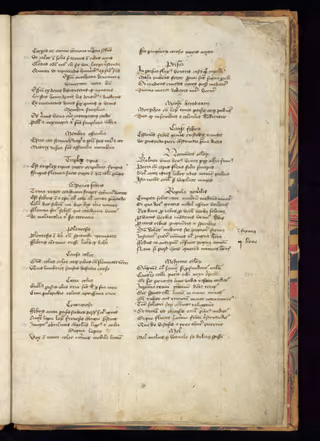
Medicine oclōrꝫ

Form
Not identifiable from book
Open the page in the book
The page this poem fills. Each opens in the Regimen sanitatis Salernitanum reader.

Hover or tap a word to see its match.

Medicines for the eyes

If the little eyes be suffused with blood or humor,

A cautery of the neck will be able to repel the harm for you.

If there be itching, hence rose water heals.

In a thin cloth let cumin be ground with the tooth;

Thus moistened with spittle, let the eye be anointed in the morning.

If redness or swelling, a greater harm is feared,

Then let white of egg be bound over with nightshade,

So however that the cloth be placed between with the eyes closed.

And if tears flow, let a constriction be given to the forehead,

Which should be prepared from bistort and ground frankincense.

Sāgīne vł some si ꝑfundantꝯ ocelli

Cautio colli potit tibi noxa r̄pelli

Si sit pruritꝰ hinc vnda rosata medetꝯ

Inpāno tenui cimīnū dēte teratꝯ

Sic sputo tīct̄ lumē in mane mīnatꝯ

Si rubor aut tumōrē maior noxa tim̄etꝯ

Tūc solatri suꝑ albugo religetūr

Si tamē vt clausis ocul̄ pānꝰ medietꝯ

Sique fluent lac̄me frōti c̄strictio detꝯ

Que de bīstosis ⁊ trito thur̄ paretur
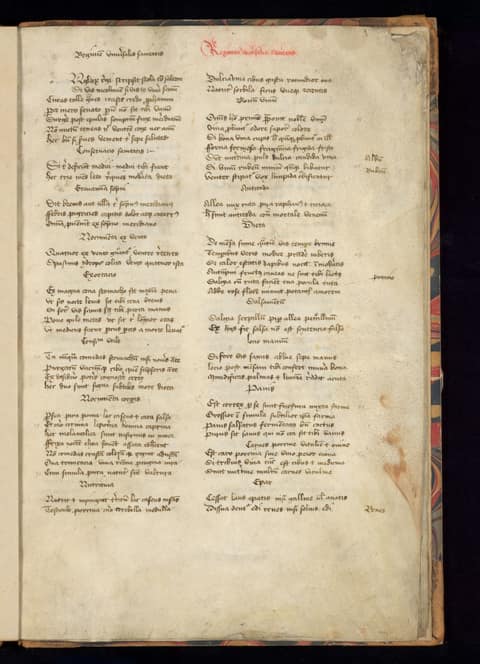
Title page of Regimen sanitatis Salernitanum
Title page of Regimen sanitatis Salernitanum , 1450

About this text

Provenance

This edition uses the Wellcome Collection images of MS 673 (catalogue number b19638425). Scans 1 to 30 show the binding, the flyleaves and the nine leaves. The Regimen fills folios 1r to 7v (scans 7 to 20). The English poems and receipts are on folios 7v to 9r (scans 20 to 23). The Wellcome images of the spine, the edges and the colour chart are not included.

The English additions are in less formal hands, and some letters are rubbed or lost. In the transcription of these pages, [?] marks letters that cannot be read.

Rights

The Wellcome Collection marks the digital images with the Public Domain Mark 1.0. Credit the Wellcome Collection.

Original scans: Wellcome Collection ( Public Domain Mark 1.0 ).

Historian’s note. This text records the medicine of its own time, and later evidence has replaced most of it. It is not medical advice. We read it as history, and we ask what, if anything, connects it to medicine today. More on how we read old medical books