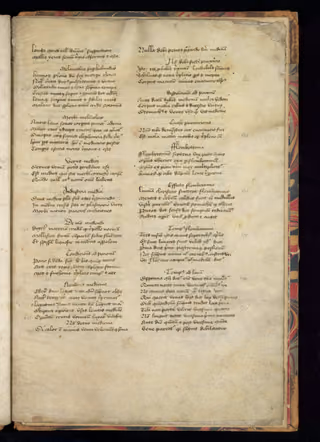
Tempꝰ ad lunā

Form
Not identifiable from book
Open the page in the book
The page this poem fills. Each opens in the Regimen sanitatis Salernitanum reader.

Hover or tap a word to see its match.

Time according to the moon

When an opportune time is given, then let your vein be bled.

The fifth harms wonderfully in all who are evacuated.

Lest you fail to beware, shun the ninth as a poisoned life.

Who seeks the veins, to these the tenth light gives pains.

Under the fifteenth, the blood tends to the lowest places.

The twenty-fourth brandishes the weapon, the gate to death.

The twenty-first does not leave the bled safe.

Before the fifth day and after the twenty-fifth,

Let the vein be spared because the blood is weakened.

Oꝑptuna qū datr tūc vena tua minūtr

Quinta nocet mira vacuats omībꝭ ī in

Ne caueas vīta nonā qī toxicā vītā

Qui querit venas hijs dat lux dēnā penas

Sub quītadēnā sāɡuis tendit loca īma

Teli neci porta vibrat vicesima quarta

Nō linquit tutos vicesima p̄ma minutos

Ante diē quītū ⁊ post vicesima qūita

Vene parcatr qꝫ sāɡuis debilitatur
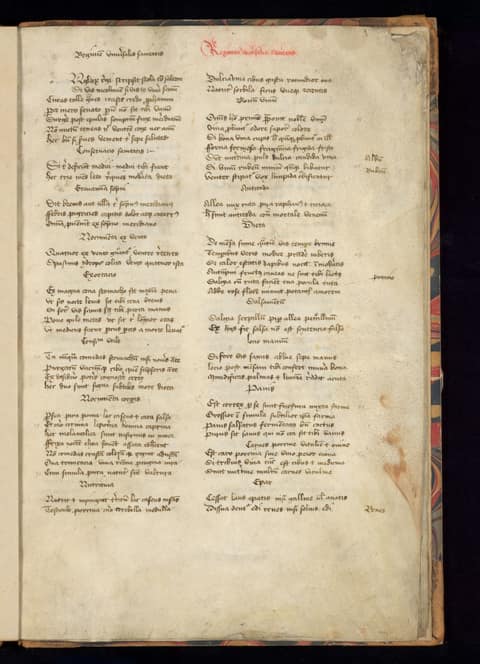
Title page of Regimen sanitatis Salernitanum
Title page of Regimen sanitatis Salernitanum , 1450

About this text

Provenance

This edition uses the Wellcome Collection images of MS 673 (catalogue number b19638425). Scans 1 to 30 show the binding, the flyleaves and the nine leaves. The Regimen fills folios 1r to 7v (scans 7 to 20). The English poems and receipts are on folios 7v to 9r (scans 20 to 23). The Wellcome images of the spine, the edges and the colour chart are not included.

The English additions are in less formal hands, and some letters are rubbed or lost. In the transcription of these pages, [?] marks letters that cannot be read.

Rights

The Wellcome Collection marks the digital images with the Public Domain Mark 1.0. Credit the Wellcome Collection.

Original scans: Wellcome Collection ( Public Domain Mark 1.0 ).

Historian’s note. This text records the medicine of its own time, and later evidence has replaced most of it. It is not medical advice. We read it as history, and we ask what, if anything, connects it to medicine today. More on how we read old medical books