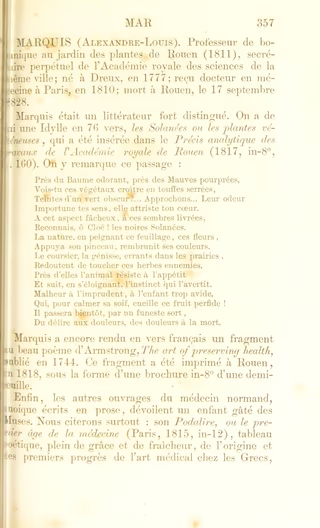
les Solanées ou les plantes vé- néneuses

Poet
Alexandre-Louis Marquis
Form
Alexandrines
Open the page in the book
The page this poem fills. Each opens in the Le Parnasse médical français reader.

Hover or tap a word to see its match.

Near the fragrant Balsam, near the purple Mallows,

Do you see those plants growing in tight clusters,

Tinted with a dark green?... Let us approach... Their odor

Troubles your senses, it saddens your heart.

By this unpleasant aspect, by these somber liveries,

Recognize, O Chloe! the black Solanaceae.

Nature, when painting this foliage, these flowers,

Pressed hard her brush, darkened her colors.

The steed, the heifer, wandering in the meadows,

Dread to touch these hostile weeds.

Near them the animal resists its appetite

And follows, by turning away, the instinct that warns it.

Woe to the imprudent one, to the overly eager child,

Who, to quench his thirst, plucks this treacherous fruit!

He will soon pass, by a fatal destiny,

From delirium to pain, from pain to death.

Près du Baume odorant, près des Mauves pourprées,

Vois-tu ces végétaux croître en touffes serrées,

Teintes d'un vert obscur ?... Approchons... Leur odeur

Importune tes sens, elle attriste ton cœur.

A cet aspect fâcheux, à ces sombres livrées,

Reconnais, ô Cloé ! les noires Solanées.

La nature, en peignant ce feuillage, ces fleurs,

Appuya son pinceau, rembrunit ses couleurs.

Le coursier, la génisse, errants dans les prairies,

Redoutent de toucher ces herbes ennemies.

Près d'elles l'animal résiste à l'appétit

Et suit, en s'éloignant, l'instinct qui l'avertit.

Malheur à l'imprudent, à l'enfant trop avide,

Qui, pour calmer sa soif, cueille ce fruit perfide !

Il passera bientôt, par un funeste sort,

Du délire aux douleurs, des douleurs à la mort.
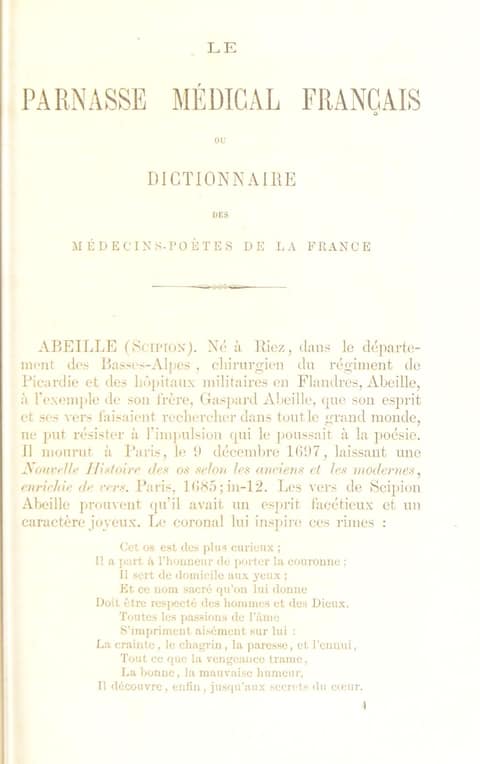
Title page of Le Parnasse médical français
Title page of Le Parnasse médical français , 1874

About this text

Provenance

This digital edition is derived from the Wellcome Collection copy of Achille Chéreau's 1874 dictionary of French physician-poets. The current reader uses the reacquired Wellcome IIIF JPEG corpus as the facsimile source of record.

Methodology

Each page is treated as a page-level unit. The page image remains the authority for the edition. Machine OCR is used as source OCR and reading aid, then corrected into French transcription, then translated into English. Word links connect the English translation to the French transcription and locations on the scans. Fifteen uncertain word-link decisions remain unlinked. Some links highlight only the text because the source word could not be located on the scan.

Rights

The source item is attributed to Wellcome Collection and marked with the Creative Commons Public Domain Mark. Poet Doctor's presentation adds generated transcription, translation, navigation metadata, and editorial context. No access control or anti-bulk-download measure should conflict with the public-domain status of the source material.

Original scans: Wellcome Collection ( Public Domain Mark 1.0 ).

Historian’s note. This text records the medicine of its own time, and later evidence has replaced most of it. It is not medical advice. We read it as history, and we ask what, if anything, connects it to medicine today. More on how we read old medical books