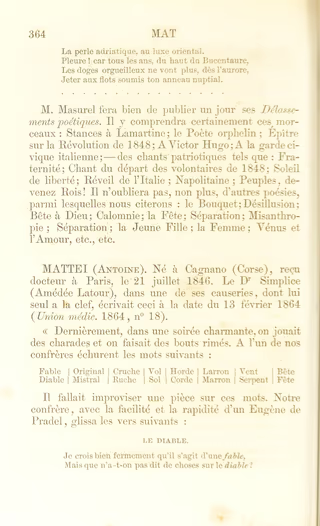
LE DIABLE.

Poet
Antoine Mattei
Form
Alexandrines
Open the page in the book
The pages this poem fills. Each opens in the Le Parnasse médical français reader.

Hover or tap a word to see its match.

I firmly believe that it is a matter of a fable,

But what has not been said about the devil?

He can take on the most *original* appearance;

Agitate mortals much more than the *mistral*

Will agitate the seas; he holds the *pitcher* of evils,

And a hundred thousand demons from the infernal *hive*

Are ready to serve him, whether by taking *flight*

In the air that surrounds us, or crawling on the *ground*.

Who would ever believe it, this cursed *horde*

Makes, to drag us away, a solid *rope*;

Each of these spirits is a petty *thief*

Who from the worst of days knows how to pull his *chestnut*.

And yet with them we play quite *often*.

Thus he who from Eve, in the guise of a *serpent*,

Managed to win favors, was not exactly *stupid*,

For man, in imitating him, does not always get a *feast*.

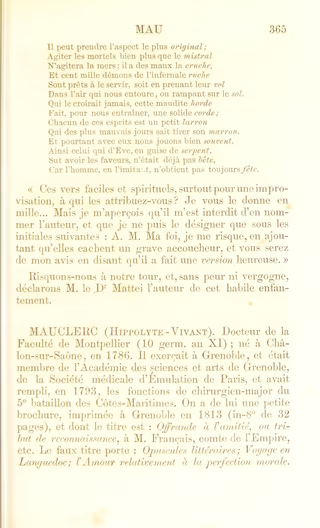
Je crois bien fermement qu'il s'agit d'une fable,

Mais que n'a-t-on pas dit de choses sur le diable ?

Il peut prendre l'aspect le plus original ;

Agiter les mortels bien plus que le mistral

N'agitera la mers ; il a des maux la cruche,

Et cent mille démons de l'infernale ruche

Sont prêts à le servir, soit en prenant leur vol

Dans l'air qui nous entoure, ou rampant sur le sol.

Qui le croirait jamais, cette maudite horde

Fait, pour nous entraîner, une solide corde ;

Chacun de ces esprits est un petit larron

Qui des plus mauvais jours sait tirer son marron.

Et pourtant avec eux nous jouons bien souvent.

Ainsi celui qui d'Eve, en guise de serpent,

Sut avoir les faveurs, n'était déjà pas bête,

Car l'homme, en l'imitant, n'obtient pas toujours fête.
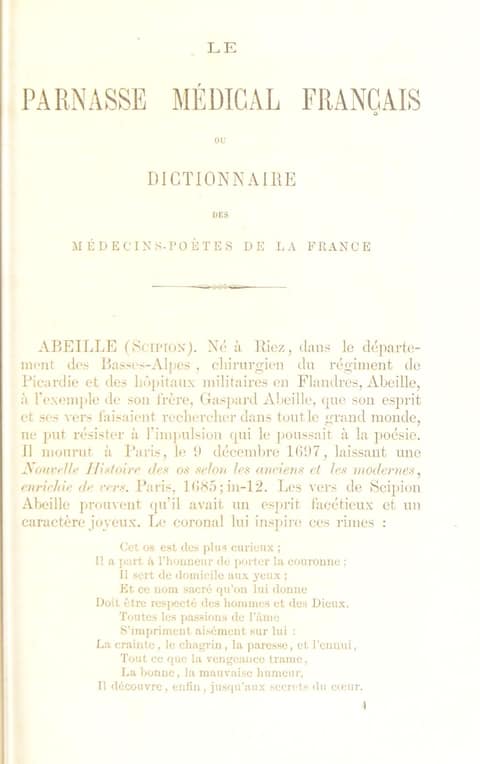
Title page of Le Parnasse médical français
Title page of Le Parnasse médical français , 1874

About this text

Provenance

This digital edition is derived from the Wellcome Collection copy of Achille Chéreau's 1874 dictionary of French physician-poets. The current reader uses the reacquired Wellcome IIIF JPEG corpus as the facsimile source of record.

Methodology

Each page is treated as a page-level unit. The page image remains the authority for the edition. Machine OCR is used as source OCR and reading aid, then corrected into French transcription, then translated into English. Word links connect the English translation to the French transcription and locations on the scans. Fifteen uncertain word-link decisions remain unlinked. Some links highlight only the text because the source word could not be located on the scan.

Rights

The source item is attributed to Wellcome Collection and marked with the Creative Commons Public Domain Mark. Poet Doctor's presentation adds generated transcription, translation, navigation metadata, and editorial context. No access control or anti-bulk-download measure should conflict with the public-domain status of the source material.

Original scans: Wellcome Collection ( Public Domain Mark 1.0 ).

Historian’s note. This text records the medicine of its own time, and later evidence has replaced most of it. It is not medical advice. We read it as history, and we ask what, if anything, connects it to medicine today. More on how we read old medical books