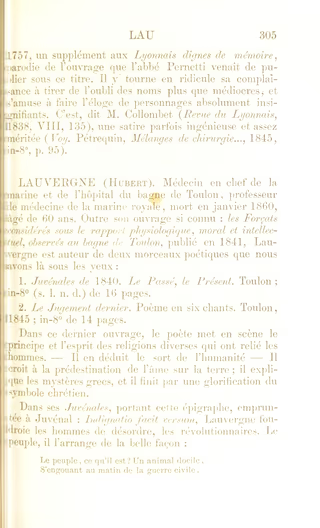
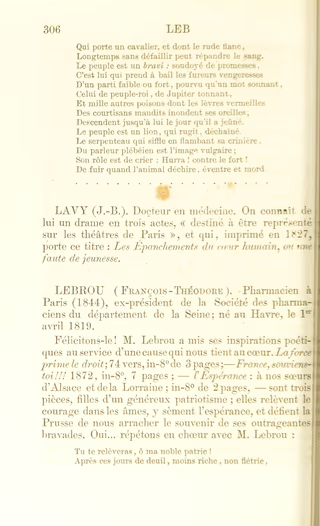
Le peuple, ce qu'il est ? Un animal docile,

Poet
Hubert Lauvergne
Form
Alexandrine
Open the page in the book
The pages this poem fills. Each opens in the Le Parnasse médical français reader.

Hover or tap a word to see its match.

The people, what are they? A docile animal,

Becoming infatuated in the morning with civil war,

Which bears a rider, and whose rough flank,

Can long shed blood without failing.

The people is a *bravi*: bribed with promises,

It is the one that leases the vengeful furies

Of a party, weak or strong, provided a resounding word,

That of people-king, of thundering Jupiter,

And a thousand other poisons with which the vermilion lips

Of accursed courtiers flood its ears,

Descend to it on the day it has fasted.

The people is a lion, that roars, unchained.

The young serpent that hisses while flaring its mane,

Is the vulgar image of the plebeian speaker;

His role is to shout: Hurrah! against the strong!

To flee when the animal tears, disembowels, and bites.

Le peuple, ce qu'il est ? Un animal docile,

S'engouant au matin de la guerre civile,

Qui porte un cavalier, et dont le rude flanc,

Longtemps sans défaillir peut répandre le sang.

Le peuple est un bravi : soudoyé de promesses,

C'est lui qui prend à bail les fureurs vengeresses

D'un parti faible ou fort, pourvu qu'un mot sonnant,

Celui de peuple-roi, de Jupiter tonnant,

Et mille autres poisons dont les lèvres vermeilles

Des courtisans maudits inondent ses oreilles,

Descendent jusqu'à lui le jour qu'il a jeûné.

Le peuple est un lion, qui rugit, déchaîné.

Le serpenteau qui siffle en flambant sa crinière,

Du parleur plébéien est l'image vulgaire ;

Son rôle est de crier : Hurra ! contre le fort !

De fuir quand l'animal déchire, éventre et mord.
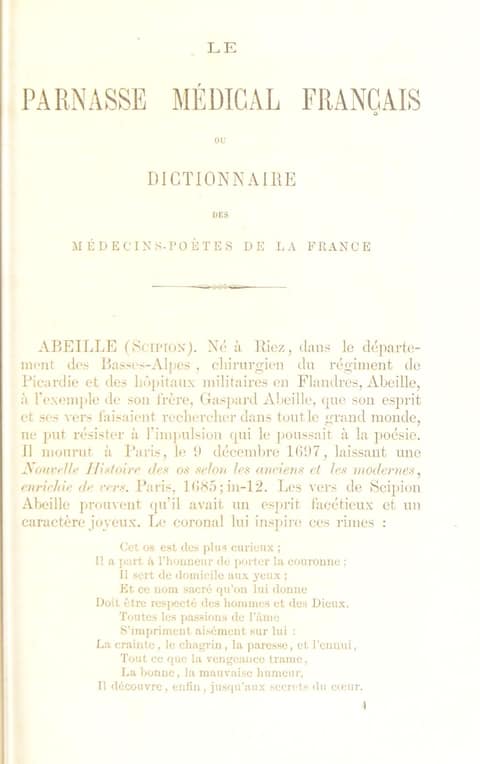
Title page of Le Parnasse médical français
Title page of Le Parnasse médical français , 1874

About this text

Provenance

This digital edition is derived from the Wellcome Collection copy of Achille Chéreau's 1874 dictionary of French physician-poets. The current reader uses the reacquired Wellcome IIIF JPEG corpus as the facsimile source of record.

Methodology

Each page is treated as a page-level unit. The page image remains the authority for the edition. Machine OCR is used as source OCR and reading aid, then corrected into French transcription, then translated into English. Word links connect the English translation to the French transcription and locations on the scans. Fifteen uncertain word-link decisions remain unlinked. Some links highlight only the text because the source word could not be located on the scan.

Rights

The source item is attributed to Wellcome Collection and marked with the Creative Commons Public Domain Mark. Poet Doctor's presentation adds generated transcription, translation, navigation metadata, and editorial context. No access control or anti-bulk-download measure should conflict with the public-domain status of the source material.

Original scans: Wellcome Collection ( Public Domain Mark 1.0 ).

Historian’s note. This text records the medicine of its own time, and later evidence has replaced most of it. It is not medical advice. We read it as history, and we ask what, if anything, connects it to medicine today. More on how we read old medical books