Hover or tap a word to see its match.
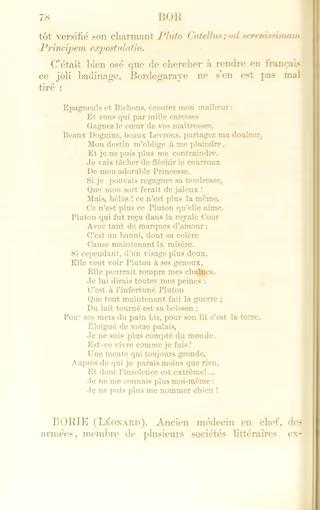
Spaniels and Bichons, listen to my misfortune;
And you who by a thousand caresses
Win the hearts of your mistresses,
Fine Pugs, fine Greyhounds, share my grief.
My fate compels me to complain,
And I can no longer restrain myself.
I will try to soften the wrath
Of my adorable Princess.
If I could regain her tenderness,
How many would envy my fate!
But, alas! she is no longer the same,
It is no longer this Pluto whom she loves,
Pluto who was received in the royal Court
With so many marks of love;
He is an exile, whose misery
Her anger now causes.
If, however, with a gentler face,
She wishes to see Pluto at her knees,
She could break my chains.
I would tell her all my sorrows:
It is upon the unfortunate Pluto
That everything now wages war;
Sour milk is his drink;
For his meals, brown bread; for his bed, the earth.
Far from your palace,
I am no longer of any account in the world.
Is it living, the way I do?
A pack that always growls,
Next to whom I seem less than nothing,
And whose insolence is extreme!...
I no longer know myself:
I can no longer call myself a dog!
Epagneuls et Bichons, écoutez mon malheur;
Et vous qui par mille caresses
Gagnez le cœur de vos maîtresses,
Beaux Doguins, beaux Levrons, partagez ma douleur.
Mon destin m'oblige à me plaindre,
Et je ne puis plus me contraindre.
Je vais tâcher de fléchir le courroux
De mon adorable Princesse.
Si je pouvais regagner sa tendresse,
Que mon sort ferait de jaloux !
Mais, hélas ! ce n'est plus la même,
Ce n'est plus ce Pluton qu'elle aime,
Pluton qui fut reçu dans la royale Cour
Avec tant de marques d'amour ;
C'est un banni, dont sa colère
Cause maintenant la misère.
Si cependant, d'un visage plus doux,
Elle veut voir Pluton à ses genoux,
Elle pourrait rompre mes chaînes.
Je lui dirais toutes mes peines :
C'est à l'infortuné Pluton
Que tout maintenant fait la guerre ;
Du lait tourné est sa boisson ;
Pour ses mets du pain bis, pour son lit c'est la terre.
Éloigné de votre palais,
Je ne suis plus compté du monde.
Est-ce vivre comme je fais ?
Une meute qui toujours gronde,
Auprès de qui je parais moins que rien,
Et dont l'insolence est extrême !...
Je ne me connais plus moi-même :
Je ne puis plus me nommer chien !