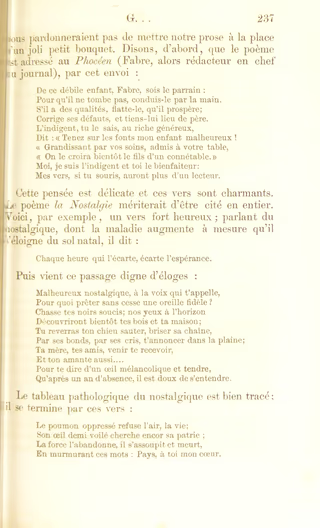
Malheureux nostalgique, à la voix qui t'appelle,

Poet
G.
Form
Alexandrine
Open the page in the book
The page this poem fills. Each opens in the Le Parnasse médical français reader.

Hover or tap a word to see its match.

Unhappy nostalgist, to the voice that calls you,

Why constantly lend a faithful ear?

Banish your dark cares; our eyes on the horizon

Will soon discover your woods and your house;

You will see your dog jump again, break his chain,

By his leaps, by his barks, announce you in the plain;

Your mother, your friends, come to welcome you,

And your lover too....

To tell you with a melancholy and tender eye,

That after a year of absence, it is sweet to hear each other.

Malheureux nostalgique, à la voix qui t'appelle,

Pour quoi prêter sans cesse une oreille fidèle ?

Chasse tes noirs soucis; nos yeux à l'horizon

Découvriront bientôt tes bois et ta maison;

Tu reverras ton chien sauter, briser sa chaîne,

Par ses bonds, par ses cris, t'annoncer dans la plaine;

Ta mère, tes amis, venir te recevoir,

Et ton amante aussi....

Pour te dire d'un œil mélancolique et tendre,

Qu'après un an d'absence, il est doux de s'entendre.
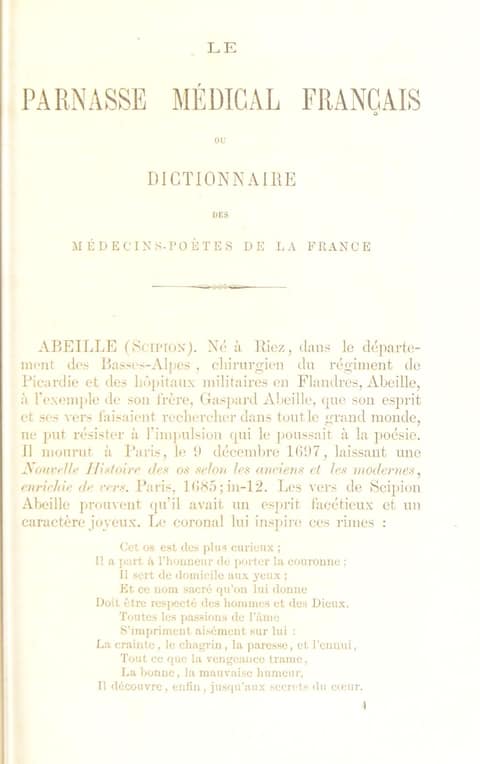
Title page of Le Parnasse médical français
Title page of Le Parnasse médical français , 1874

About this text

Provenance

This digital edition is derived from the Wellcome Collection copy of Achille Chéreau's 1874 dictionary of French physician-poets. The current reader uses the reacquired Wellcome IIIF JPEG corpus as the facsimile source of record.

Methodology

Each page is treated as a page-level unit. The page image remains the authority for the edition. Machine OCR is used as source OCR and reading aid, then corrected into French transcription, then translated into English. Word links connect the English translation to the French transcription and locations on the scans. Fifteen uncertain word-link decisions remain unlinked. Some links highlight only the text because the source word could not be located on the scan.

Rights

The source item is attributed to Wellcome Collection and marked with the Creative Commons Public Domain Mark. Poet Doctor's presentation adds generated transcription, translation, navigation metadata, and editorial context. No access control or anti-bulk-download measure should conflict with the public-domain status of the source material.

Original scans: Wellcome Collection ( Public Domain Mark 1.0 ).

Historian’s note. This text records the medicine of its own time, and later evidence has replaced most of it. It is not medical advice. We read it as history, and we ask what, if anything, connects it to medicine today. More on how we read old medical books