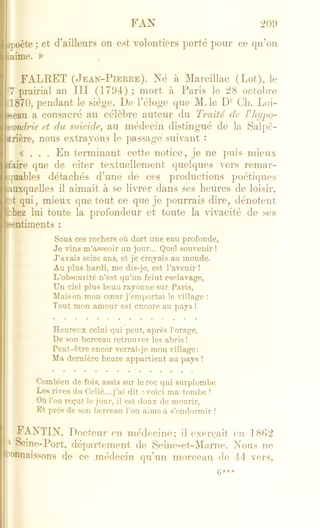
Sous ces rochers où dort une eau profonde,

Poet
Jean-Pierre Falret
Form
Mixed (decasyllable and alexandrine)
Open the page in the book
The page this poem fills. Each opens in the Le Parnasse médical français reader.

Hover or tap a word to see its match.

Beneath these rocks where a deep water sleeps,

I came to sit one day... What a memory!

I was sixteen, and I believed in the world.

To the boldest, I told myself, belongs the future!

Obscurity is but a feigned slavery,

A more beautiful sky shines upon Paris,

But in my heart I carried away the village:

All my love is still in the country!

Happy is he who can, after the storm,

Find the shelters of his cradle again!

Perhaps I shall yet see my village:

My last hour belongs to the country!

How many times, seated on the rock that overhangs

The banks of the Cellé... have I said: here is my tomb!

Where one received the light of day, it is sweet to die,

And near one's cradle one loves to fall asleep!

Sous ces rochers où dort une eau profonde,

Je vins m'asseoir un jour... Quel souvenir !

J'avais seize ans, et je croyais au monde.

Au plus hardi, me dis-je, est l'avenir !

L'obscurité n'est qu'un feint esclavage,

Un ciel plus beau rayonne sur Paris,

Mais en mon cœur j'emportai le village :

Tout mon amour est encore au pays !

Heureux celui qui peut, après l'orage,

De son berceau retrouver les abris !

Peut-être encor verrai-je mon village :

Ma dernière heure appartient au pays !

Combien de fois, assis sur le roc qui surplombe

Les rives du Cellé... j'ai dit : voici ma tombe !

Où l'on reçut le jour, il est doux de mourir,

Et près de son berceau l'on aime à s'endormir !
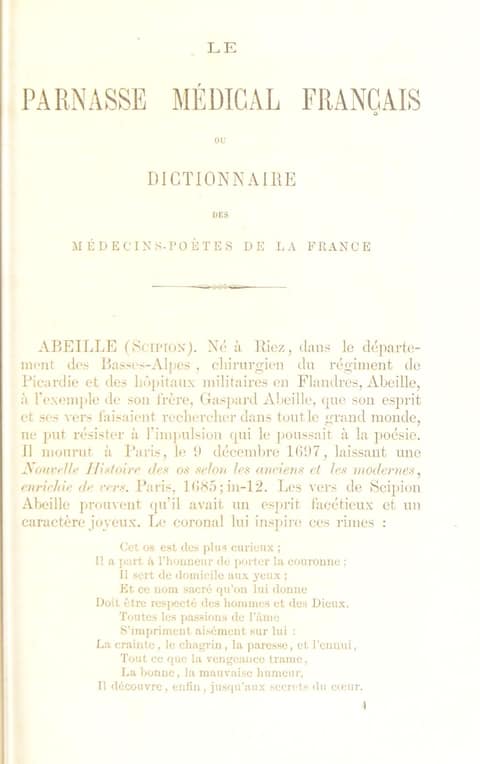
Title page of Le Parnasse médical français
Title page of Le Parnasse médical français , 1874

About this text

Provenance

This digital edition is derived from the Wellcome Collection copy of Achille Chéreau's 1874 dictionary of French physician-poets. The current reader uses the reacquired Wellcome IIIF JPEG corpus as the facsimile source of record.

Methodology

Each page is treated as a page-level unit. The page image remains the authority for the edition. Machine OCR is used as source OCR and reading aid, then corrected into French transcription, then translated into English. Word links connect the English translation to the French transcription and locations on the scans. Fifteen uncertain word-link decisions remain unlinked. Some links highlight only the text because the source word could not be located on the scan.

Rights

The source item is attributed to Wellcome Collection and marked with the Creative Commons Public Domain Mark. Poet Doctor's presentation adds generated transcription, translation, navigation metadata, and editorial context. No access control or anti-bulk-download measure should conflict with the public-domain status of the source material.

Original scans: Wellcome Collection ( Public Domain Mark 1.0 ).

Historian’s note. This text records the medicine of its own time, and later evidence has replaced most of it. It is not medical advice. We read it as history, and we ask what, if anything, connects it to medicine today. More on how we read old medical books