Hover or tap a word to see its match.
Grow, young branches: Zephyr, returning,
Announces Philomene to the surrounding echoes.
Come, nymphs, come, the crystal of the fountains
Has managed to break the chains of the fleeing winter.
Plunge your beautiful hands into the transparent waves,
Grass covers the banks of your wandering streams,
And already a few flowers, leaning over their waters,
Delay their vagabond course in the meadows.
Grow, flowers of the groves; already the green branches
With their moving foliage shade the hillsides.
For the fifteenth time, you see the swallows,
O Naïs, flutter over the new stems;
For you, in nature, in the rays of a beautiful day,
Rise at once both spring and love;
And, among so many flowers the meadow offers you,
Only Chromis always knows how to choose the most florid.
Grow, fresh shades, fortunate groves,
Destined by the gods for the mysteries of love.
It is for those who know how to love that spring displays
Its floral adornments, its triumphal robe!
It is for those who know how to love that the young birds
Mingle their joyous songs with the murmur of the waters!
You whom in our cities they name the most beautiful,
Hasten, Flora awaits you, the nightingale calls you!
Grow, smiling groves, crown yourselves with flowers:
She comes, the beauty that all hearts follow.
Thus, at the water's edge, my muse contemplates you;
Your verdant domes will become a temple.
Receive her; show to her enchanted eyes
Your deep refuges, your artless beauties.
And may, at my accents, which your aspect inspires,
One of your flowers descend upon her lyre!
Grow, vast forests, majestic oaks;
Cover the winding paths with cool shade....
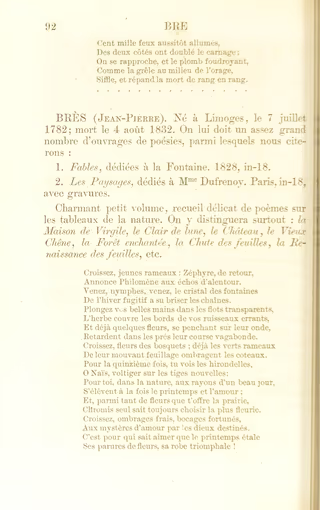
Croissez, jeunes rameaux : Zéphyre, de retour,
Annonce Philomène aux échos d'alentour.
Venez, nymphes, venez, le cristal des fontaines
De l'hiver fugitif a su briser les chaînes.
Plongez vos belles mains dans les flots transparents,
L'herbe couvre les bords de vos ruisseaux errants,
Et déjà quelques fleurs, se penchant sur leur onde,
Retardent dans les prés leur course vagabonde.
Croissez, fleurs des bosquets ; déjà les verts rameaux
De leur mouvant feuillage ombragent les coteaux.
Pour la quinzième fois, tu vois les hirondelles,
O Naïs, voltiger sur les tiges nouvelles;
Pour toi, dans la nature, aux rayons d'un beau jour,
S'élèvent à la fois le printemps et l'amour ;
Et, parmi tant de fleurs que t'offre la prairie,
Chromis seul sait toujours choisir la plus fleurie.
Croissez, ombrages frais, bocages fortunés,
Aux mystères d'amour par les dieux destinés.
C'est pour qui sait aimer que le printemps étale
Ses parures de fleurs, sa robe triomphale !
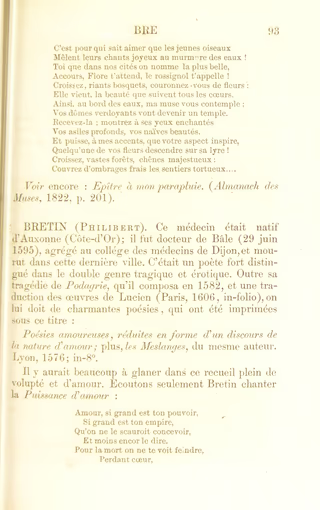
C'est pour qui sait aimer que les jeunes oiseaux
Mêlent leurs chants joyeux au murmure des eaux !
Toi que dans nos cités on nomme la plus belle,
Accours, Flore t'attend, le rossignol t'appelle !
Croissez, riants bosquets, couronnez-vous de fleurs :
Elle vient, la beauté que suivent tous les cœurs.
Ainsi, au bord des eaux, ma muse vous contemple ;
Vos dômes verdoyants vont devenir un temple.
Recevez-la ; montrez à ses yeux enchantés
Vos asiles profonds, vos naïves beautés.
Et puisse, à mes accents, que votre aspect inspire,
Quelqu'une de vos fleurs descendre sur sa lyre !
Croissez, vastes forêts, chênes majestueux ;
Couvrez d'ombrages frais les sentiers tortueux....