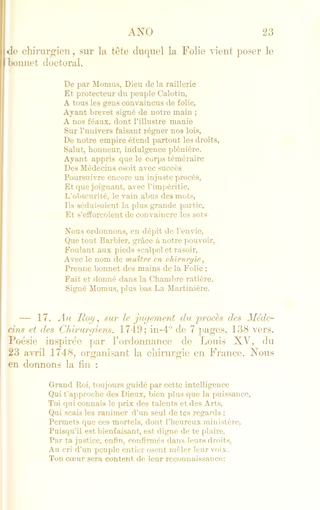
De par Momus, Dieu de la raillerie

Form
Decasyllabe
Open the page in the book
The page this poem fills. Each opens in the Le Parnasse médical français reader.

Hover or tap a word to see its match.

In the name of Momus, God of mockery

And protector of the Calotin people,

To all people convicted of folly,

Holding a patent signed by our hand;

To our lieges, whose illustrious mania

Making our laws reign over the universe,

Extends the rights of our empire everywhere,

Greetings, honor, and plenary indulgence.

Having learned that the reckless body

Of Physicians dared with success

To pursue again an unjust lawsuit,

And that joining, with ineptitude,

Obscurity, the vain abuse of words,

They seduced the greater part,

And strove to convince the fools.

We ordain, in spite of envy,

That every Barber, thanks to our power,

Trampling scalpel and razor underfoot,

With the name of *master of surgery*,

Shall take the cap from the hands of Folly;

Done and given in the Rat-trap Chamber.

Signed Momus, lower down La Martinière.

De par Momus, Dieu de la raillerie

Et protecteur du peuple Calotin,

A tous les gens convaincus de folie,

Ayant brevet signé de notre main ;

A nos féaux, dont l'illustre manie

Sur l'univers faisant régner nos lois,

De notre empire étend partout les droits,

Salut, honneur, indulgence plénière.

Ayant appris que le corps téméraire

Des Médecins osoit avec succès

Poursuivre encore un injuste procès,

Et que joignant, avec l'impéritie,

L'obscurité, le vain abus des mots,

Ils séduisoient la plus grande partie,

Et s'efforcoient de convaincre les sots.

Nous ordonnons, en dépit de l'envie,

Que tout Barbier, grâce à notre pouvoir,

Foulant aux pieds scalpel et rasoir,

Avec le nom de maître en chirurgie,

Prenne bonnet des mains de la Folie ;

Fait et donné dans la Chambre ratière.

Signé Momus, plus bas La Martinière.
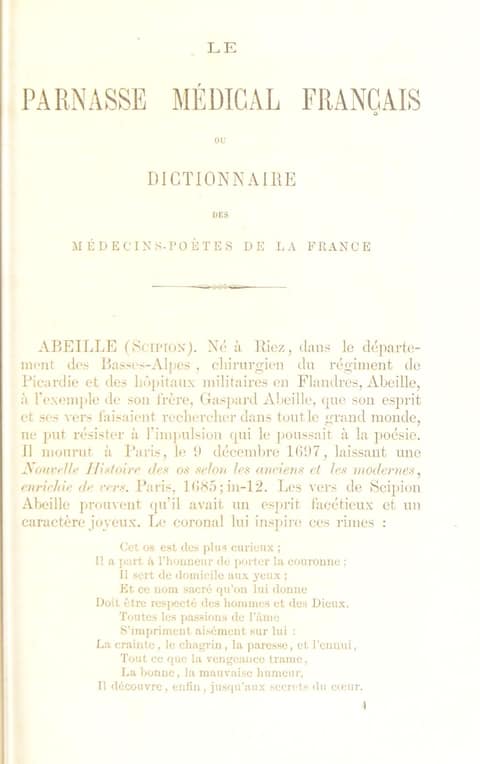
Title page of Le Parnasse médical français
Title page of Le Parnasse médical français , 1874

About this text

Provenance

This digital edition is derived from the Wellcome Collection copy of Achille Chéreau's 1874 dictionary of French physician-poets. The current reader uses the reacquired Wellcome IIIF JPEG corpus as the facsimile source of record.

Methodology

Each page is treated as a page-level unit. The page image remains the authority for the edition. Machine OCR is used as source OCR and reading aid, then corrected into French transcription, then translated into English. Word links connect the English translation to the French transcription and locations on the scans. Fifteen uncertain word-link decisions remain unlinked. Some links highlight only the text because the source word could not be located on the scan.

Rights

The source item is attributed to Wellcome Collection and marked with the Creative Commons Public Domain Mark. Poet Doctor's presentation adds generated transcription, translation, navigation metadata, and editorial context. No access control or anti-bulk-download measure should conflict with the public-domain status of the source material.

Original scans: Wellcome Collection ( Public Domain Mark 1.0 ).

Historian’s note. This text records the medicine of its own time, and later evidence has replaced most of it. It is not medical advice. We read it as history, and we ask what, if anything, connects it to medicine today. More on how we read old medical books