Hover or tap a word to see its match.
We, lord of the pale realms,
Prince of the sulfurous shores,
Tyrant of Peoples and of Kings,
Ordain that Surgery,
Our loyal and good friend,
Be restored to all her rights;
That her despotic oppressors
And all these empiric dunces
Themselves tremble beneath her laws;
And decree, consequently,
That all Bath-keepers, Barbers,
Bloodletters, Fraters, and Wigmakers,
Be, despite science,
Declared our High Justiciars,
And the only physicians in France;
That without examinations, or talents,
The most pitiful Wigmakers
Be admitted into their college,
And may, with privilege,
Exterminate all the living.
We forbid all learned men
To trouble them in their maneuvers,
With any good medicines,
Or by the sacrilegious charm
Of the Boerhaaves and the Hofmans,
Under penalty, for all offenders,
Of being accused of sorcery.
We declare fallen and proscribed
(And order them to be banned)
All these scoundrels of fine wits,
Whose works and writings
Are fatal to our Empire.
And we will that they be molested,
Harassed, cursed, slapped,
Declared thieves and fit for hanging,
Infamous, brigands and felons,
Until the irrevocable moments
When their deplorable phantoms
Shall come to fry in my skillets.
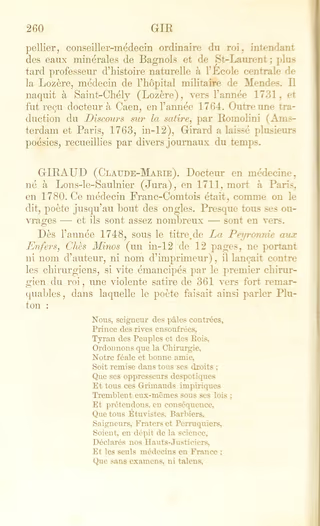
Nous, seigneur des pâles contrées,
Prince des rives ensoufrées,
Tyran des Peuples et des Rois,
Ordonnons que la Chirurgie,
Notre féale et bonne amie,
Soit remise dans tous ses droits ;
Que ses oppresseurs despotiques
Et tous ces Grimauds impiriques
Tremblent eux-mêmes sous ses lois ;
Et prétendons, en conséquence,
Que tous Étuvistes, Barbiers,
Saigneurs, Fraters et Perruquiers,
Soient, en dépit de la science,
Déclarés nos Hauts-Justiciers,
Et les seuls médecins en France ;
Que sans examens, ni talens,
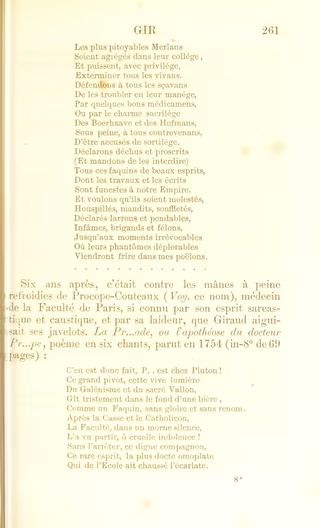
Les plus pitoyables Merlans
Soient agrégés dans leur collége,
Et puissent, avec privilége,
Exterminer tous les vivans.
Défendons à tous les sçavans
De les troubler en leur manége,
Par quelques bons médicamens,
Ou par le charme sacrilége
Des Boerhaave et des Hofmans,
Sous peine, à tous contrevenans,
D'être accusés de sortilége.
Déclarons déchus et proscrits
(Et mandons de les interdire)
Tous ces faquins de beaux esprits,
Dont les travaux et les écrits
Sont funestes à notre Empire.
Et voulons qu'ils soient molestés,
Houspillés, maudits, souffletés,
Déclarés larrons et pendables,
Infâmes, brigands et félons,
Jusqu'aux moments irrévocables
Où leurs phantômes déplorables
Viendront frire dans mes poëlons.