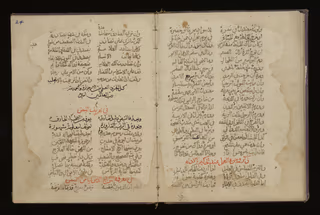
Mention of the physician's recourse to action by deductions

ذكر رجوع العمل عند الحكيم بالادله

Poet
Ibn Sina
Form
Rajaz
Open the page in the book
The page this poem fills. Each opens in the Ibn Sina's Urjuza fi al-tibb and other medical works in MS Arabic 129 reader.

Hover or tap a word to see its match.

And adhere to analogy in the sick person / if you want to judge by deduction.

And in the deduction, its powers are true / and usually, other than it is false.

As for what is true in the prognostics / it is what happens to the head from the organs.

And if you see the true one of them as a witness / and its like in a body that opposes it.

But we see upon opposition / in the weak body, some anomalies.

So whatever opposes the sign / is true in healing and safety.

And whatever contradicts the prognostics / is true in death, so there is no survival.

And if the signs are contradictory to you / being weak, then that is a permanent doubt.

Stop making judgments and decisions / and be hopeful regarding the matter.

And stop if they are equal from a cause / and judge if they lean towards the majority.

والتزم القياس في العليل / اذا اردت الحكم بالدليل

وفي الدليل صادق قواه / وعادة كاذبة سواه

اما الذي يصدق في الانباء / فحادث الراس من الاعضاء

وان ترى الصادق منها شاهدة / ومثله في بدن يضاده

لكنما نرى على تضاد / في البدن الضعيف من شواذ

فكلما يضادد العلامة / يصدق في الشفاء والسلامة

وكلما يخالف الانباء / يصدق في الموت فلا بقاء

وان تضادت لك العلائم / ضعيفة فذاك شك دايم

قف عن الاحكام والقضاء / وكن من الامر على رجاء

وقف اذا تعادلت عن موجب / واقض اذا ترجحت بالاغلب
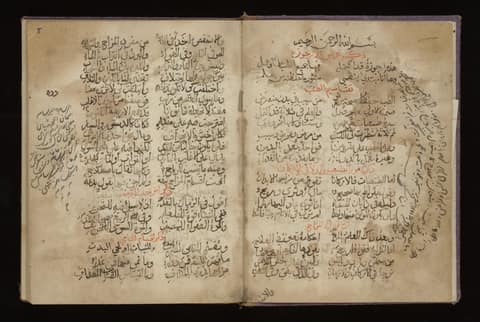
Title page of Ibn Sina's Urjuza fi al-tibb and other medical works in MS Arabic 129
Title page of Ibn Sina's Urjuza fi al-tibb and other medical works in MS Arabic 129 , 1700

About this text

Provenance

MS Arabic 129 is a handwritten Arabic medical volume held by Wellcome Collection in London. It is a composite manuscript: a single volume that brings together 11 separate works. They cover bloodletting, circumcision, the seasons, anatomy, the pulse, and urine, and most are in verse. Most of the verse in this edition is Ibn Sina's Urjuza fi al-tibb, a long poem on medicine, identified from the catalog card in the scans and from the poem's opening lines. Wellcome also names Ibn al-Tilmidh and Ibn Makki among the authors. Shams al-Din ibn Makki wrote three short poems here, and some pieces cannot be identified from the book. The manuscript is undated, and Wellcome estimates it as 18th century.

Methodology

Each scan is treated as a page-level unit. The page image remains the authority for the edition. Local Arabic Kraken OCR was weak and used only as auxiliary context; Gemini generated scan-grounded Arabic transcription and English translation primarily from the manuscript images and the approved glossary. Some word links remain uncertain, and some words have no reliable location on the scan.

Rights

The Wellcome Collection source record marks the digital surrogate with the Public Domain Mark 1.0. Poet Doctor's presentation adds generated OCR, transcription, translation, navigation metadata, and editorial context.

Original scans: Wellcome Collection ( Public Domain Mark 1.0 ).

Historian’s note. This text records the medicine of its own time, and later evidence has replaced most of it. It is not medical advice. We read it as history, and we ask what, if anything, connects it to medicine today. More on how we read old medical books