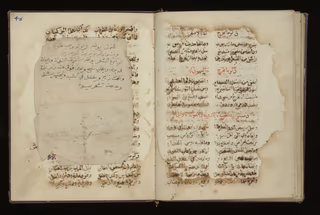
دستور في كتب الادويه والقول الاوايل

Poet
Ibn Sina
Form
Rajaz
Open the page in the book
The page this poem fills. Each opens in the Ibn Sina's Urjuza fi al-tibb and other medical works in MS Arabic 129 reader.

Hover or tap a word to see its match.

And the principle that clarifies the simple drug / until you see its effects in every disease

And it is only called to the compound / for a reason I am about to mention

The arrangement of diseases and the preparation of a drug / and what sweetens it [illegible] for food

And what aids the thing in taking effect / if it is swift in penetration

And what helps against the choking of swallowing / and what helps in loosening the bowels

And two are counted of what is compounded / the first of the rule is the compound

Take a dose of everything that purges / and count it, for it is not neglected

And mix with it whatever you wish anew / and sum the weights by calculation

And divide the weight among the doses / thus do the compounds act

So whatever comes for a dose from a number / then give him to drink an ounce for a number

واصل ما يبيض الدواء مفرده / حتي تري افعاله في كل دواء

وانما دُعي الي المركّب / ما انا ذا اقوله من سبب

ترتيب امراض واصلاح دواء / وما تجلبه بوسي للغذاء

وما يعين الشئ بالتنفيذ / ان كان جريا علي النفوذ

وما يحسنه لحسن البلع / وما يعين في انطلاق الطبع

واثنان عدت يا لمكي / اول الدستور المحركات

خذ شربة من كان شيا يسهل / وعُدّها فانها لا تهمل

وامزج بها ما شئت من جديد / واجمع الاوزان بالحساب

واقسم الوزن علي الشربات / كذاك تفعل المركبات

فما اتي لشربة من عدة / فاسقه اوقية لعدة
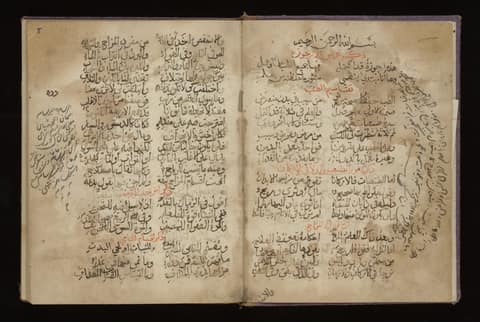
Title page of Ibn Sina's Urjuza fi al-tibb and other medical works in MS Arabic 129
Title page of Ibn Sina's Urjuza fi al-tibb and other medical works in MS Arabic 129 , 1700

About this text

Provenance

MS Arabic 129 is a handwritten Arabic medical volume held by Wellcome Collection in London. It is a composite manuscript: a single volume that brings together 11 separate works. They cover bloodletting, circumcision, the seasons, anatomy, the pulse, and urine, and most are in verse. Most of the verse in this edition is Ibn Sina's Urjuza fi al-tibb, a long poem on medicine, identified from the catalog card in the scans and from the poem's opening lines. Wellcome also names Ibn al-Tilmidh and Ibn Makki among the authors. Shams al-Din ibn Makki wrote three short poems here, and some pieces cannot be identified from the book. The manuscript is undated, and Wellcome estimates it as 18th century.

Methodology

Each scan is treated as a page-level unit. The page image remains the authority for the edition. Local Arabic Kraken OCR was weak and used only as auxiliary context; Gemini generated scan-grounded Arabic transcription and English translation primarily from the manuscript images and the approved glossary. Some word links remain uncertain, and some words have no reliable location on the scan.

Rights

The Wellcome Collection source record marks the digital surrogate with the Public Domain Mark 1.0. Poet Doctor's presentation adds generated OCR, transcription, translation, navigation metadata, and editorial context.

Original scans: Wellcome Collection ( Public Domain Mark 1.0 ).

Historian’s note. This text records the medicine of its own time, and later evidence has replaced most of it. It is not medical advice. We read it as history, and we ask what, if anything, connects it to medicine today. More on how we read old medical books