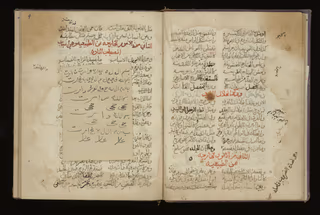
ذكر انحلال الفرد

Poet
Ibn Sina
Form
Rajaz
Open the page in the book
The page this poem fills. Each opens in the Ibn Sina's Urjuza fi al-tibb and other medical works in MS Arabic 129 reader.

Hover or tap a word to see its match.

Indeed, the loss of continuity is found / In a single organ or in a part

Thus it is paired like the undoing of a knot / And like the severing of **the leg or the hand**

And the single [instance] in the bones is a fracture / And in the membrane and veins it is a tear

And what appears lengthwise or crosswise / In a nerve, like a split or a crush

And a rupture in a ligament or a tendon / Is like a cracking in it, or like an amputation

And what afflicts the flesh is a wound / And if the matter persists, it is an ulcer

And what occurs in a muscle is a tearing / **And what removes the skin is an excoriation**

الا يوجد انحلال الفرد / في مفرد الاعضا او في فرد

فمزدوج مثل انحلال العقد / ومثل قطع **الرجل او اليد**

والفرد في العظام وهو كسر / وفي الغشاء والعروق خرق

وما انبرى بالطول او بالعرض / من عصب كالشق او كالرض

والهتك في الرباط او في الوتر / مثل انصداع فيه او كالبتر

وما اصاب اللحم فهو جرح / وان تمادى الامر فهو قرح

وما عرى في عضل ففسخ / **وما ابان الجلد فهو سلخ**
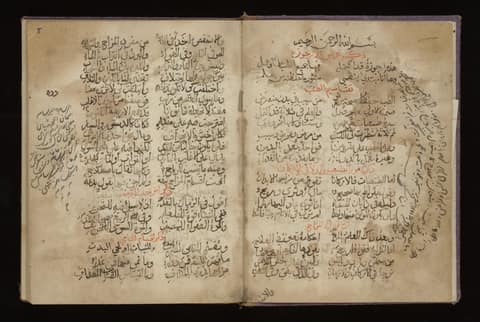
Title page of Ibn Sina's Urjuza fi al-tibb and other medical works in MS Arabic 129
Title page of Ibn Sina's Urjuza fi al-tibb and other medical works in MS Arabic 129 , 1700

About this text

Provenance

MS Arabic 129 is a handwritten Arabic medical volume held by Wellcome Collection in London. It is a composite manuscript: a single volume that brings together 11 separate works. They cover bloodletting, circumcision, the seasons, anatomy, the pulse, and urine, and most are in verse. Most of the verse in this edition is Ibn Sina's Urjuza fi al-tibb, a long poem on medicine, identified from the catalog card in the scans and from the poem's opening lines. Wellcome also names Ibn al-Tilmidh and Ibn Makki among the authors. Shams al-Din ibn Makki wrote three short poems here, and some pieces cannot be identified from the book. The manuscript is undated, and Wellcome estimates it as 18th century.

Methodology

Each scan is treated as a page-level unit. The page image remains the authority for the edition. Local Arabic Kraken OCR was weak and used only as auxiliary context; Gemini generated scan-grounded Arabic transcription and English translation primarily from the manuscript images and the approved glossary. Some word links remain uncertain, and some words have no reliable location on the scan.

Rights

The Wellcome Collection source record marks the digital surrogate with the Public Domain Mark 1.0. Poet Doctor's presentation adds generated OCR, transcription, translation, navigation metadata, and editorial context.

Original scans: Wellcome Collection ( Public Domain Mark 1.0 ).

Historian’s note. This text records the medicine of its own time, and later evidence has replaced most of it. It is not medical advice. We read it as history, and we ask what, if anything, connects it to medicine today. More on how we read old medical books