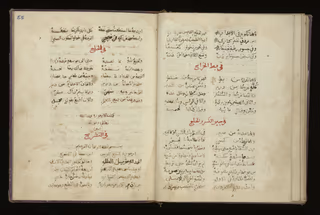
On bone-setting a fracture and dislocation

في جبر الكسر والخلع

Poet
Ibn Sina
Form
Rajaz
Open the page in the book
The page this poem fills. Each opens in the Ibn Sina's Urjuza fi al-tibb and other medical works in MS Arabic 129 reader.

Hover or tap a word to see its match.

And for what you align of a cleft / In the bone, like a fracture or like a dislocation,

And for what you bind of a fracture / Its treatment is indeed by bone-setting.

Return the splinters in it until it fits together / And bind them wherever they agree.

And bind them with firm craftsmanship / Not compressing it, nor loosening.

A bandage, bind firmly with it in the middle / Then the binding is increased until you tie it,

From above it, correspondingly wrapped / From below it, splints and wool,

And the liniment, its glue is first / And its alum in parts so that it does not swell,

And beware for it at first of swelling / Appease what pours into it of blood.

Repel it as much as you can until you prevent it / With every cold [remedy] so that it benefits it.

And prevent him from moving it out of restlessness / Make him adhere to patience throughout the long stillness.

ولما تعدله من صدعِ / في العظم مثل الكسر او كالخلعِ

ولما تربطه من كسرِ / فانما علاجه بالجبرِ

ردّ الشظايا فيه حتى ينطبقْ / وشدّها بحيثما فتتفقْ

وشدّها بصنعة محكمةِ / لا ضاغط فيها ولا مرخيةِ

عصابة شدّا بها في الوسطِ / ثم يزاد الشدّ حتى تربطِ

من فوقها من قابل ملفوفة / من تحتها جباير وصوفة

والطلي غراوه في الاولِ / وشبّه اجزاء كي لا يمتلي

واحذر عليه اولا من ورمِ / سكن بما ينصبّ فيه من دمِ

اردعه ما استطعت اى منفعة / بكل بارد لكي ما ينفعه

وامنعه من تحريكه من ضجره / الزمه في طول السكون الصبره
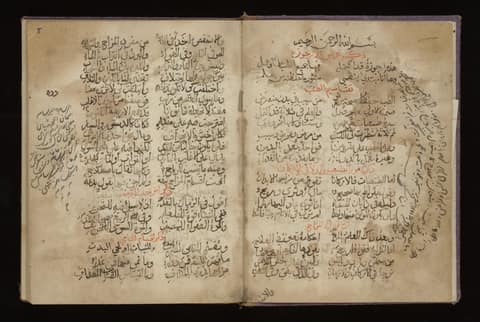
Title page of Ibn Sina's Urjuza fi al-tibb and other medical works in MS Arabic 129
Title page of Ibn Sina's Urjuza fi al-tibb and other medical works in MS Arabic 129 , 1700

About this text

Provenance

MS Arabic 129 is a handwritten Arabic medical volume held by Wellcome Collection in London. It is a composite manuscript: a single volume that brings together 11 separate works. They cover bloodletting, circumcision, the seasons, anatomy, the pulse, and urine, and most are in verse. Most of the verse in this edition is Ibn Sina's Urjuza fi al-tibb, a long poem on medicine, identified from the catalog card in the scans and from the poem's opening lines. Wellcome also names Ibn al-Tilmidh and Ibn Makki among the authors. Shams al-Din ibn Makki wrote three short poems here, and some pieces cannot be identified from the book. The manuscript is undated, and Wellcome estimates it as 18th century.

Methodology

Each scan is treated as a page-level unit. The page image remains the authority for the edition. Local Arabic Kraken OCR was weak and used only as auxiliary context; Gemini generated scan-grounded Arabic transcription and English translation primarily from the manuscript images and the approved glossary. Some word links remain uncertain, and some words have no reliable location on the scan.

Rights

The Wellcome Collection source record marks the digital surrogate with the Public Domain Mark 1.0. Poet Doctor's presentation adds generated OCR, transcription, translation, navigation metadata, and editorial context.

Original scans: Wellcome Collection ( Public Domain Mark 1.0 ).

Historian’s note. This text records the medicine of its own time, and later evidence has replaced most of it. It is not medical advice. We read it as history, and we ask what, if anything, connects it to medicine today. More on how we read old medical books