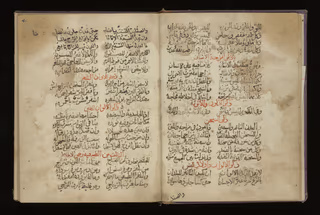
ذكر الألوان ودلائل البشر

Poet
Ibn Sina
Form
Rajaz
Open the page in the book
The page this poem fills. Each opens in the Ibn Sina's Urjuza fi al-tibb and other medical works in MS Arabic 129 reader.

Hover or tap a word to see its match.

The indicator by colors is not accepted / if the influence is from the lands,

As with the Zanj, where it changed the bodies / until it clothed their skins in blackness,

And the Saqaliba were clothed in whiteness, / until their skins became plump [and white].

And if you examine the seven climes, / you will be knowledgeable of the types of temperament.

The most balanced of them is the straight fourth, / and the color in it follows the temperament.

The tawny-yellow is for yellow bile, / and the dusky dust-colored is for black bile.

And the red body is from an excess of blood, / and the ivory white is phlegm.

And the white tinged with redness, / its temperament is balanced in proportion.

لا يقبل الدليل بالالوان / ان يكن التأثير للبلدان

بالزنج حيث غيّر الأجسادا / حتى كسا جلودها سوادا

والصقلبة اكتست بياضا / حتى غدت جلودها بضاضا

وان تجد السبعة الاقالما / تكن بانواع المزاج عالما

فالعدل منها المستقيم الرابع / واللون فيه للمزاج تابع

الادم الاصفر للصفراء / والكمد الاغبر للسوداء

والجسد الأحمر من فرط الدم / والابيض العاجي هو البلغم

والابيض المشوب باحمرار / مزاجه معتدل المقدار
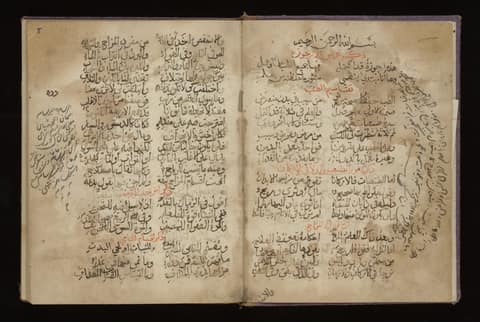
Title page of Ibn Sina's Urjuza fi al-tibb and other medical works in MS Arabic 129
Title page of Ibn Sina's Urjuza fi al-tibb and other medical works in MS Arabic 129 , 1700

About this text

Provenance

MS Arabic 129 is a handwritten Arabic medical volume held by Wellcome Collection in London. It is a composite manuscript: a single volume that brings together 11 separate works. They cover bloodletting, circumcision, the seasons, anatomy, the pulse, and urine, and most are in verse. Most of the verse in this edition is Ibn Sina's Urjuza fi al-tibb, a long poem on medicine, identified from the catalog card in the scans and from the poem's opening lines. Wellcome also names Ibn al-Tilmidh and Ibn Makki among the authors. Shams al-Din ibn Makki wrote three short poems here, and some pieces cannot be identified from the book. The manuscript is undated, and Wellcome estimates it as 18th century.

Methodology

Each scan is treated as a page-level unit. The page image remains the authority for the edition. Local Arabic Kraken OCR was weak and used only as auxiliary context; Gemini generated scan-grounded Arabic transcription and English translation primarily from the manuscript images and the approved glossary. Some word links remain uncertain, and some words have no reliable location on the scan.

Rights

The Wellcome Collection source record marks the digital surrogate with the Public Domain Mark 1.0. Poet Doctor's presentation adds generated OCR, transcription, translation, navigation metadata, and editorial context.

Original scans: Wellcome Collection ( Public Domain Mark 1.0 ).

Historian’s note. This text records the medicine of its own time, and later evidence has replaced most of it. It is not medical advice. We read it as history, and we ask what, if anything, connects it to medicine today. More on how we read old medical books