Hover or tap a word to see its match.
Greetings, people! May God deliver you from all evil!
I offer you the tribute of this little book;
For love of you I made it, Friend, enjoy it;
For the welfare of the people is my supreme law.
And reviewing your political life,
I will tell you plainly, in my rustic fashion,
That, with each to his own trade, you would live comfortably and joyously,
If you were less fickle, if you were not so credulous.
I will borrow the voice of wise prudence
Which says: "To be happy, follow this maxim:
Help yourself, poor child, and God will help you;
Use common sense, and happiness will shower upon you."
To open your eyes perhaps hope deceives me:
I know that hope promises and ultimately refuses;
But I also know that, if you have gone astray,
It only takes, to guide you, a single ray of light.
Thus the Mariner, departed without a compass,
On the tossing of the sea, lost toward the pole,
Follows the path to the port, when he can, by the glimmer,
Discovers in the sky the star that lights him.
Let another, singing to you for the profit of his glory,
Fill with your name the temple of Memory;
Great will be his work, humble will be my lute,
I weep for your errors, poor People, greetings!
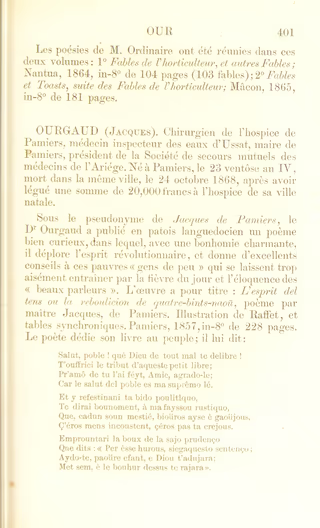
Salut, poble ! què Dieu de tout mal te delibre !
T'ouffrici le tribut d'aqueste petit libre;
Pr'amô de tu l'ai féyt, Amie, agrado-le;
Car le salut del poble es ma suprêmo lé.
Et y refestinani ta bido poulitîquo,
Te dirai bounoment, à ma fayssou rustiquo,
Que, cadun soun mestié, bioüros ayse è gaoüjous,
Ç'éros mens incoustent, çéros pas ta crejous.
Emprountari la boux de la sajo prudenço
Que dits : « Per èsse hurous, siegaquesto sentenço;
Aydo-te, paoüre efant, e Diou t'adujara;
Met sem, è le bouhur dessus te rajara ».
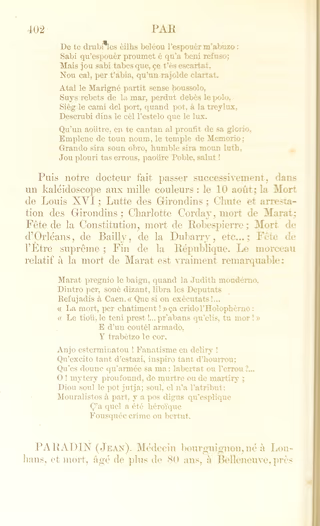
De te drubi les èilhs beléou l'espouèr m'abuzo :
Sabi qu'espouèr proumet è qu'a beni refuso;
Mais jou sabi tabes que, çe t'ès escartat,
Nou cal, per t'abia, qu'un rajolde clartat.
Atal le Marigné partit sense boussolo,
Suys rebets de la mar, perdut debès le polo,
Sièg le cami del port, quand pot, à la treylux,
Descrubi dins le cèl l'estelo que le lux.
Qu'un aoütre, en te cantan al proufit de sa glorio,
Emplene de toun noum, le temple de Memorio ;
Grando sira soun obro, humble sira moun luth,
Jou plouri tas errous, paoüre Poble, salut !