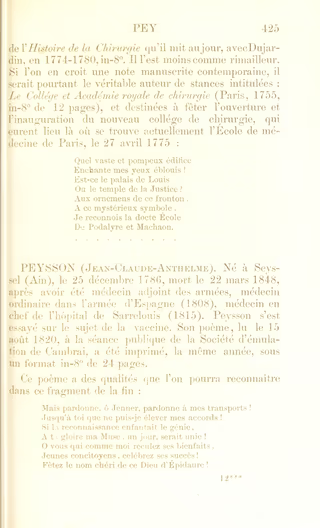
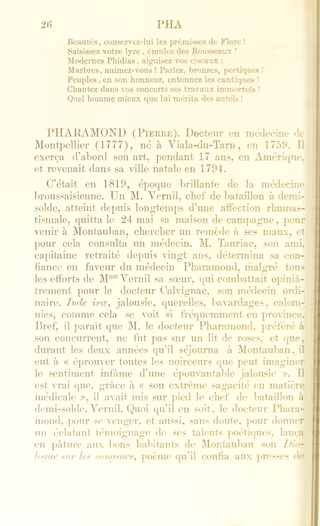
Mais pardonne, ô Jenner, pardonne à mes transports !

Poet
Jean-Claude-Anthelme Peysson
Form
Alexandrine
Open the page in the book
The pages this poem fills. Each opens in the Le Parnasse médical français reader.

Hover or tap a word to see its match.

But forgive, O Jenner, forgive my raptures!

Why can I not raise my strains to you!

If gratitude gave birth to genius,

To your glory my Muse, one day, would be united!

O you who like me extend its benefits,

Young fellow citizens, celebrate his successes!

Honor the cherished name of this God of Epidaurus!

Beauties, preserve for him the first fruits of Flora!

Seize your lyre, emulators of the Rousseaus!

Modern Phidiases, sharpen your chisels;

Marbles, come to life! Speak, bronzes, porticoes!

Peoples, in his honor, intone hymns!

Sing of his immortal works in your concerts!

What man better than he deserved altars!

Mais pardonne, ô Jenner, pardonne à mes transports !

Jusqu'à toi que ne puis-je élever mes accords !

Si la reconnaissance enfantait le génie,

A ta gloire ma Muse, un jour, serait unie !

O vous qui comme moi reculez ses bienfaits,

Jeunes concitoyens, célébrez ses succès !

Fêtez le nom chéri de ce Dieu d'Épidaure !

Beautés, conservez-lui les prémisses de Flore !

Saisissez votre lyre, émules des Rousseaux !

Modernes Phidias, aiguisez vos ciseaux ;

Marbres, animez-vous ! Parlez, bronzes, portiques !

Peuples, en son honneur, entonnez les cantiques !

Chantez dans vos concerts ses travaux immortels !

Quel homme mieux que lui mérita des autels !
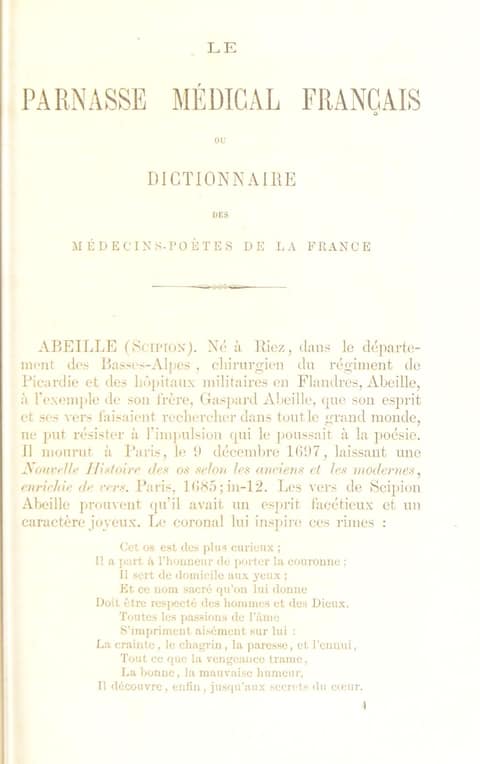
Title page of Le Parnasse médical français
Title page of Le Parnasse médical français , 1874

About this text

Provenance

This digital edition is derived from the Wellcome Collection copy of Achille Chéreau's 1874 dictionary of French physician-poets. The current reader uses the reacquired Wellcome IIIF JPEG corpus as the facsimile source of record.

Methodology

Each page is treated as a page-level unit. The page image remains the authority for the edition. Machine OCR is used as source OCR and reading aid, then corrected into French transcription, then translated into English. Word links connect the English translation to the French transcription and locations on the scans. Fifteen uncertain word-link decisions remain unlinked. Some links highlight only the text because the source word could not be located on the scan.

Rights

The source item is attributed to Wellcome Collection and marked with the Creative Commons Public Domain Mark. Poet Doctor's presentation adds generated transcription, translation, navigation metadata, and editorial context. No access control or anti-bulk-download measure should conflict with the public-domain status of the source material.

Original scans: Wellcome Collection ( Public Domain Mark 1.0 ).

Historian’s note. This text records the medicine of its own time, and later evidence has replaced most of it. It is not medical advice. We read it as history, and we ask what, if anything, connects it to medicine today. More on how we read old medical books