Hover or tap a word to see its match.
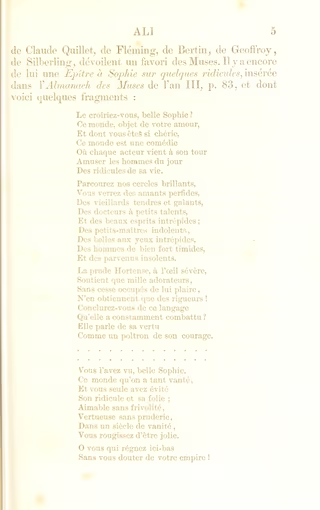
Would you believe it, beautiful Sophie?
This world, the object of your love,
And by which you are so cherished,
This world is a comedy
Where each actor comes in his turn
To amuse the men of the day
With the absurdities of his life.
Survey our brilliant circles,
You will see perfidious lovers,
Tender and gallant old men,
Doctors with minor talents,
And intrepid wits;
Indolent fops,
Beauties with intrepid eyes,
Very timid good men,
And insolent upstarts.
The prude Hortense, with a severe eye,
Maintains that a thousand adorers,
Incessantly occupied with pleasing her,
Obtain from her only harshness!
Will you conclude from this language
That she has constantly resisted?
She speaks of her virtue
Like a coward of his courage.
You have seen it, beautiful Sophie,
This world that has been so praised,
And you alone have avoided
Its absurdity and its folly;
Amiable without frivolity,
Virtuous without prudery,
In a century of vanity,
You blush at being pretty.
O you who reign here below
Without suspecting your empire!
You, whose grace and charms
Are a stumbling block for satire,
How sweet it is for you to be able to laugh
At the flaws you do not have!
Le croiriez-vous, belle Sophie ?
Ce monde, objet de votre amour,
Et dont vous êtes si chérie,
Ce monde est une comédie
Où chaque acteur vient à son tour
Amuser les hommes du jour
Des ridicules de sa vie.
Parcourez nos cercles brillants,
Vous verrez des amants perfides,
Des vieillards tendres et galants,
Des docteurs à petits talents,
Et des beaux esprits intrépides ;
Des petits-maîtres indolents,
Des belles aux yeux intrépides,
Des hommes de bien fort timides,
Et des parvenus insolents.
La prude Hortense, à l'œil sévère,
Soutient que mille adorateurs,
Sans cesse occupés de lui plaire,
N'en obtiennent que des rigueurs !
Conclurez-vous de ce langage
Qu'elle a constamment combattu ?
Elle parle de sa vertu
Comme un poltron de son courage.
Vous l'avez vu, belle Sophie,
Ce monde qu'on a tant vanté,
Et vous seule avez évité
Son ridicule et sa folie ;
Aimable sans frivolité,
Vertueuse sans pruderie,
Dans un siècle de vanité,
Vous rougissez d'être jolie.
O vous qui régnez ici-bas
Sans vous douter de votre empire !
Vous, dont la grâce et les appas
Sont un écueil pour la satire,
Qu'il vous est doux de pouvoir rire
Des travers que vous n'avez pas !